Count me in!
Stay up to date with the latest news, announcements, and articles.
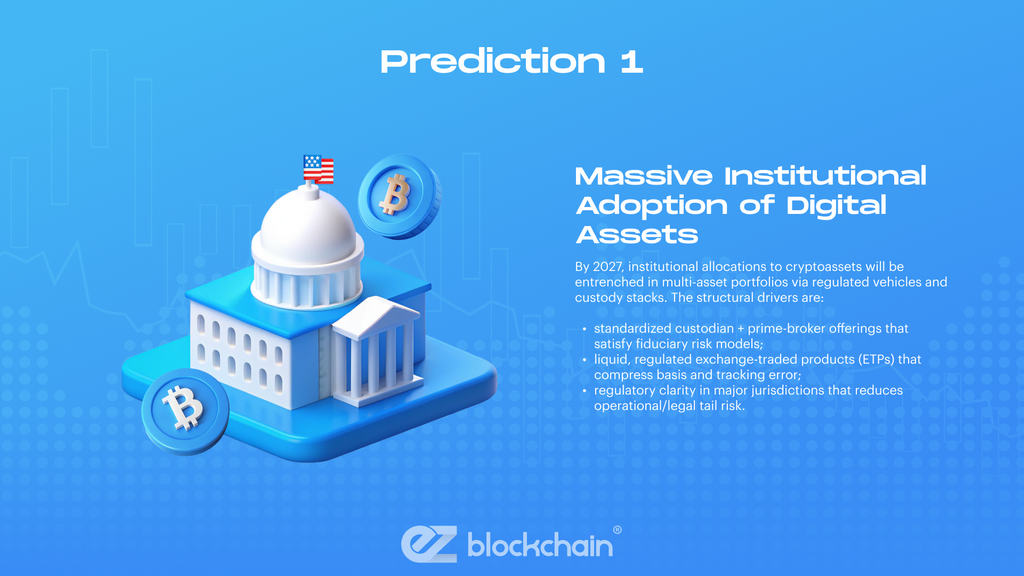
By 2027, institutional allocations to cryptoassets will be entrenched in multi-asset portfolios via regulated vehicles and custody stacks. The structural drivers are: (a) standardized custodian + prime-broker offerings that satisfy fiduciary risk models; (b) liquid, regulated exchange-traded products (ETPs) that compress basis and tracking error; and (c) regulatory clarity in major jurisdictions that reduces operational/legal tail risk.
Empirical benchmark: spot Bitcoin ETPs rapidly aggregated assets in 2024–2025, with the largest single product reaching tens of billions in AUM within months of launch, a structural signal that institutional channels now function at scale .
Institutional adoption will not be binary (in/out). Expect three correlated technical effects:
A practical implication for crypto market microstructure: the marginal liquidity provider will increasingly be a central counterparty or custodian-managed pool, shifting some price discovery away from permissionless orderbooks and toward portfolio-level rebalancing flows.
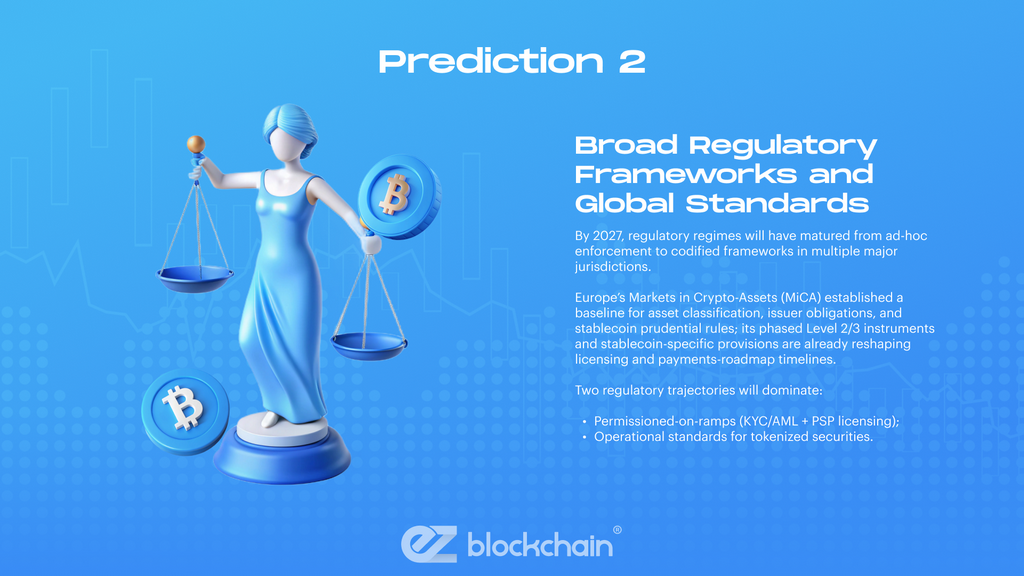
By 2027, regulatory regimes will have matured from ad-hoc enforcement to codified frameworks in multiple major jurisdictions. Europe’s Markets in Crypto-Assets (MiCA) established a baseline for asset classification, issuer obligations, and stablecoin prudential rules; its phased Level 2/3 instruments and stablecoin-specific provisions are already reshaping licensing and payments-roadmap timelines .
Two regulatory trajectories will dominate:
Where regulation is clear, institutional risk premiums compress; where it is ambiguous, expect fragmentation and regulatory arbitrage. For asset managers and protocol engineers, the pragmatic prioritization is compliance-by-design: embed auditability, revocability, and KYC/AML hooks into token issuance and settlement layers.
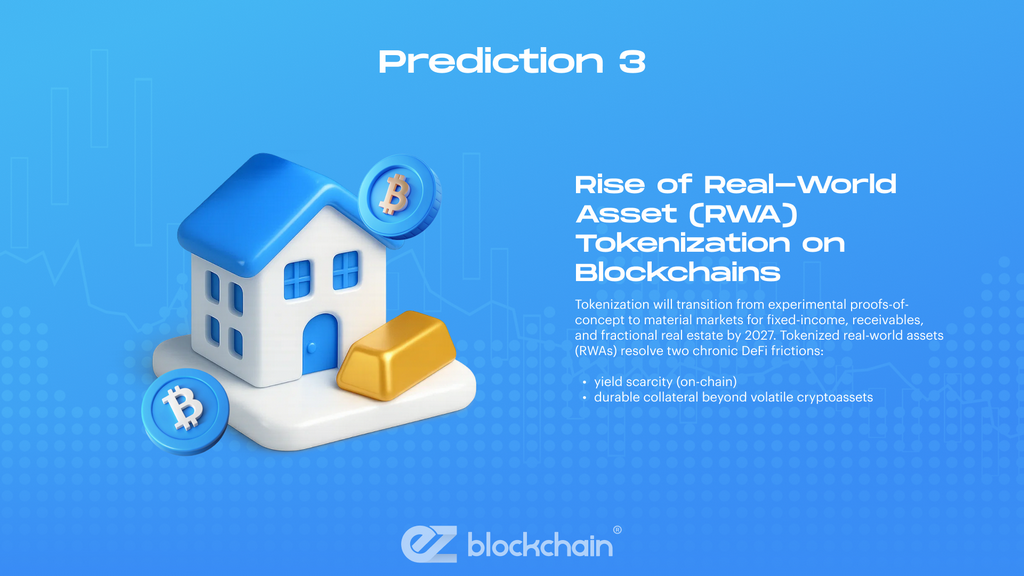
Tokenization will transition from experimental proofs-of-concept to material markets for fixed-income, receivables, and fractional real estate by 2027. Tokenized real-world assets (RWAs) resolve two chronic DeFi frictions: (1) yield scarcity (on-chain), and (2) durable collateral beyond volatile cryptoassets.
Benchmarks:
Selected 2024–2025 Benchmarks (public data synthesis).
| Metric | 2024–2025 Baseline | Primary source / note |
| Spot Bitcoin ETP AUM (largest single fund) | Tens of billions USD within first year | ETF inflows / fund reports. |
| Stablecoin transfer volume (annual) | ~$20–28 trillion (2024 baseline estimates vary) | WEF / industry reports . |
| Tokenized assets on-chain (total) | ~$100–200 billion (est.) | Industry coalition surveys and RWA trackers . |
| DeFi Total Value Locked (TVL) | ~100–200+ billion (volatile across quarters) | DeFi TVL aggregators . |
This table synthesizes public figures to show the relative magnitudes that will anchor tokenization demand. The key technical delta for 2027 is not the token primitive itself, but the legal-engineered wrapper that reconciles on-chain transferability with off-chain enforceability (custodial trust frameworks, legal transfer agents, and negotiated smart-contract dispute resolution).
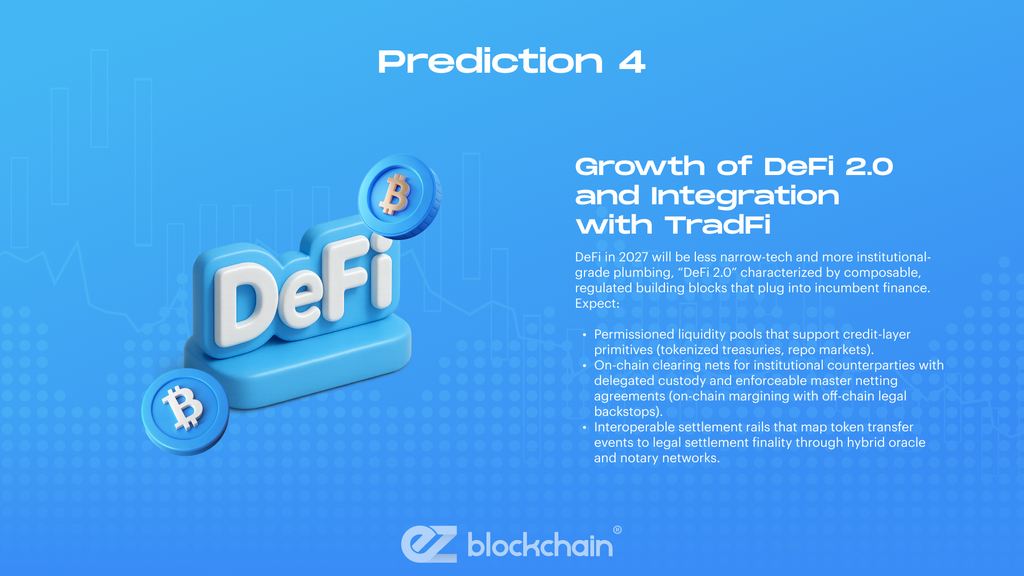
DeFi in 2027 will be less narrow-tech and more institutional-grade plumbing, “DeFi 2.0” characterized by composable, regulated building blocks that plug into incumbent finance. Expect:
Empirical signal: DeFi TVL and protocol revenues rebounded in 2025, suggesting renewed liquidity appetites and increasing institutional interaction with on-chain liquidity primitives .
A concrete technical consequence: liquidity fragmentation across L1s/L2s will be mitigated by cross-chain settlement bridges that support atomic settlement across tokenized instruments, but those bridges will require stricter cryptoeconomic security proofs and insurance backstops to meet institutional capital requirements.
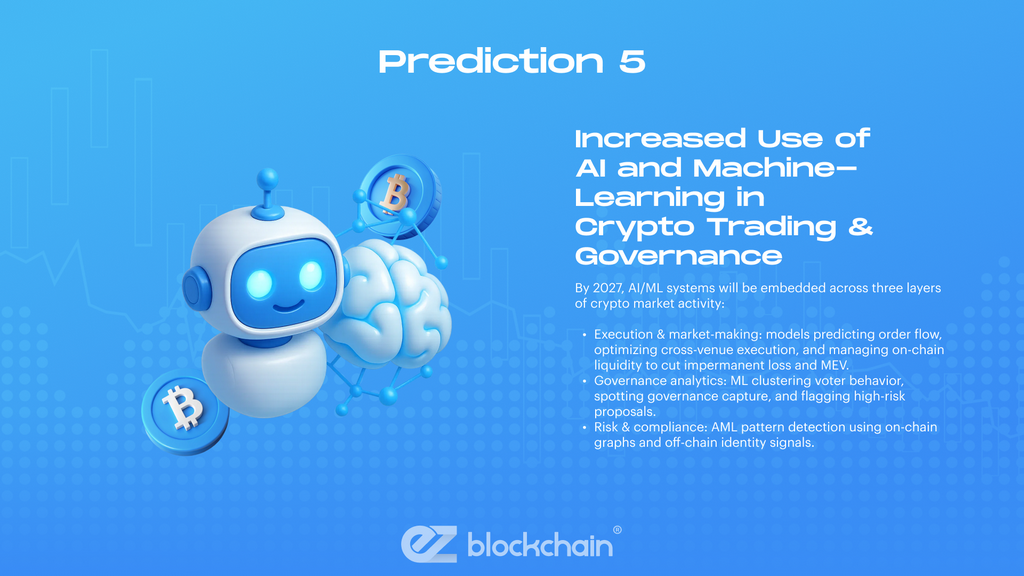
By 2027, AI/ML systems will be embedded across three layers of crypto market activity:
Multiple academic and industry reviews in 2024-2025 document growing ML adoption in crypto trading, and industry coverage reports note an accelerating role for AI in automated trading systems. Practical constraints remain model overfitting to noisy on-chain signals, execution latency, and economic costs of gas, but the adoption curve is steep .
Operational implication: trading desks and protocol risk teams will need to incorporate model-risk governance (MRG) practices, versioning, backtests against realistic transaction cost models, and fail-safe kill switches, otherwise automated agents will amplify systemic shocks.
Macro variables remain first-order drivers: rate policy, inflation regimes, dollar strength, and global liquidity. Higher real yields compress speculative risk premia and increase the hurdle rate for crypto allocations; a disinflationary environment and rate cuts typically re-risk markets and can propagate into higher crypto valuations via equity and risk premia channels. Additionally, geopolitical fragmentation and capital controls in some jurisdictions will increase demand for tokenized cross-border settlement via stablecoins and regulated on-chain rails.
Technically, cross-asset correlation matrices will be tighter during macro stress: expect increases in volatility spillovers and regime shifts where crypto behaves more like a macro-risk-on asset than a store-of-value, depending on capital flows into ETFs and tokenized debt markets.
Stablecoins will continue to provide the practical rails for on-chain settlement, settlement finality, and programmable cash. Aggregate transfer volumes in recent public reports (2024-2025) already exceed many traditional card networks, indicating stablecoins’ centrality to on-chain liquidity and settlement.
CBDCs will co-exist with stablecoins: wholesale CBDCs will be leveraged for interbank settlement and potentially for tokenized RWA clearing, while retail CBDCs may dampen some stablecoin use-cases in payments but not necessarily in programmability and composability required by DeFi primitives. The net outcome is a layered liquidity stack where stablecoins handle trust-minimized programmatic flows and CBDCs handle regulated settlement between banks.
Three systemic risks will be dominant in 2027:
Mitigants include multi-jurisdiction compliance engineering, insurance and capital buffers, standardized custody proofs, and coordinated supervisory stress tests for tokenized markets.
Below are concrete, technical recommendations for investors positioning for 2027. Each bullet is actionable and rooted in the structural dynamics described above.
These recommendations are operationally specific: they emphasize custody, access vehicle selection, due diligence on token economics for RWAs, and governance controls for ML systems. They are actionable for asset managers, treasury desks, and advanced allocators.
Taken together, these five predictions point to an industry that will be more institutional, regulated, and technologically integrated by 2027, but also one where the marginal sources of fragility will migrate from pure-tech exploits to legal, operational, and model-risk failures. The smartest participants will be those that engineer compliance and model governance into protocol and portfolio design from day one.
Fill out a form and our bitcoin mining expert will contact you.
FREE CONSULTATIONFill out a form and our bitcoin mining expert will contact you.