Count me in!
Stay up to date with the latest news, announcements, and articles.


Crypto markets, especially for assets like Bitcoin and major altcoins, tend to move in cycles that combine supply‑side triggers (like block‑reward halvings), macroeconomic cycles, and speculative behavior. The periodicity is often more pronounced than traditional assets due to high volatility, retail participation, and rapid innovation cycles .
For Bitcoin in particular, the 2024 halving reset the issuance schedule: new supply of BTC shrunk by half, tightening supply inflow and historically setting the stage for a bull‑market run over the following 12–24 months .
That means 2025–2026 is likely to be a high‑volatility, high‑opportunity window, making it prudent to define profit‑taking thresholds and compounding strategies now, before emotions or FOMO can distort judgment.
A structured profit-taking framework avoids emotional, reactive decisions, and allows for balance between realizing gains and staying exposed to upside.
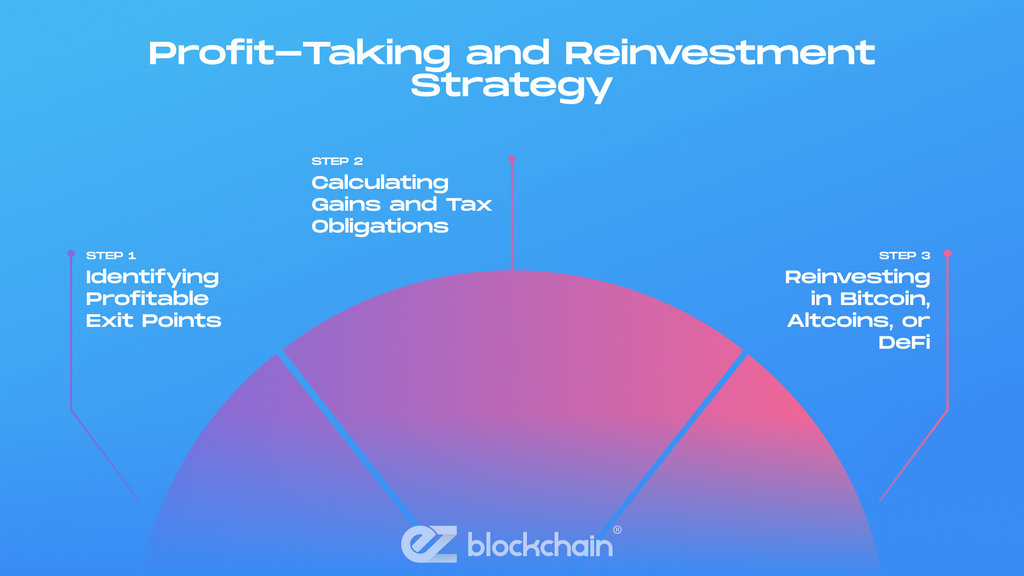
Instead of trying to “sell the top,” a systematically defined exit strategy tends to be more effective and less psychologically taxing. Many seasoned crypto investors and traders use a tiered profit‑taking model: partial sales at predefined multiples of cost basis or target gains .
Common exit triggers include:
This kind of structured exit strategy reduces reliance on market timing or “gut feelings,” helping avoid holding through crashes or selling too early during dips.
Before executing any profit-taking, it’s vital to compute net gains and understand tax implications and cost-base adjustments. Crypto profits are taxable events, disposing of assets (selling, swapping, or converting to fiat) triggers capital gains, and gains realized within one year are typically taxed at ordinary income rates; longer‑term holdings may enjoy more favorable tax treatment .
When calculating gains:
After deductions, the resulting net gain determines your realized profit. This is the capital you can either withdraw, convert to fiat/stablecoin, or redeploy.
Profit-taking should always be preceded by a rigorous calculation of net return and tax liability, skipping this step risks overestimating actual gains or running into unexpected tax bills.
With realized profits in hand, the next question is where to reinvest. 2026’s crypto landscape offers multiple high-potential avenues: core assets (like Bitcoin or major altcoins), DeFi protocols for yield, or a diversified basket to spread risk. Key considerations:
A hybrid reinvestment strategy that blends core holdings, selective altcoin exposure, and yield‑oriented positions balances growth potential and risk control.
Reinvestment is not necessarily about chasing the highest‑return asset, but about positioning your capital efficiently across different risk‑return profiles, combining stability, growth, and yield in a balanced manner.
Yield-bearing mechanisms, staking, liquidity provisioning, and yield farming, can be leveraged to compound gains from profit-taking. Instead of simply holding, reinvested capital can earn passive returns that supplement asset appreciation.
Practical approach: Mint or stake tokens on audited platforms, or provide liquidity in stablecoin/major‑asset pools to reduce impermanent‑loss exposure, while collecting yield. Many platforms continue to offer competitive APYs as of 2025, making yield‑compounding a viable long-term strategy .
This strategy suits investors who want to keep capital deployed, avoid idle funds, and maximize compounding over medium-to-long horizons.
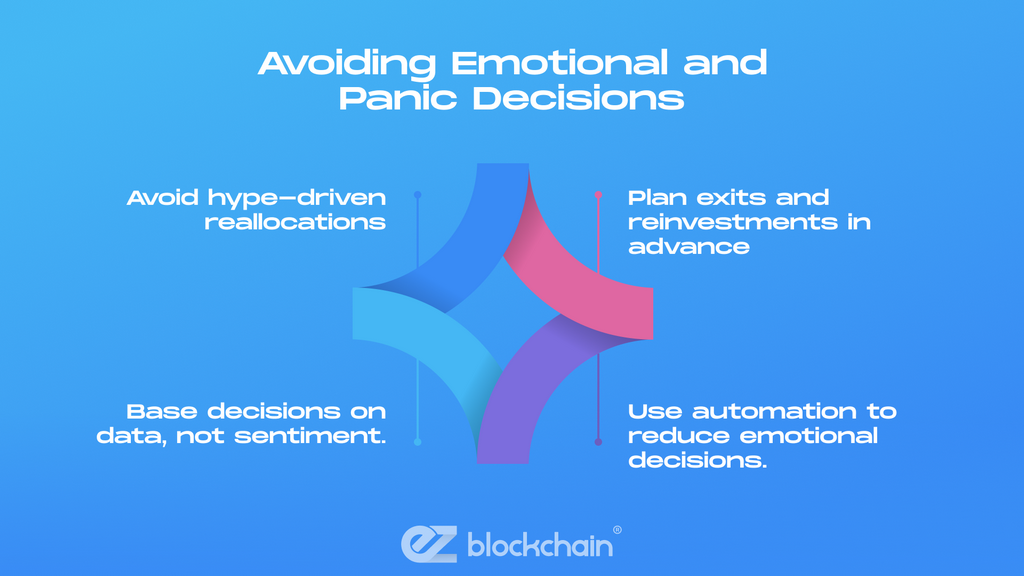
One of the biggest enemies of sustainable growth is emotion, fear, greed, FOMO. If profit-taking or reinvesting is left to emotional impulses, long-term results often suffer. To avoid that:
Emotional discipline is a core differentiator between successful crypto investors and those who get burned. Establish your rules, automate what you can, and treat reinvestment like a strategic financial plan, not gambling.
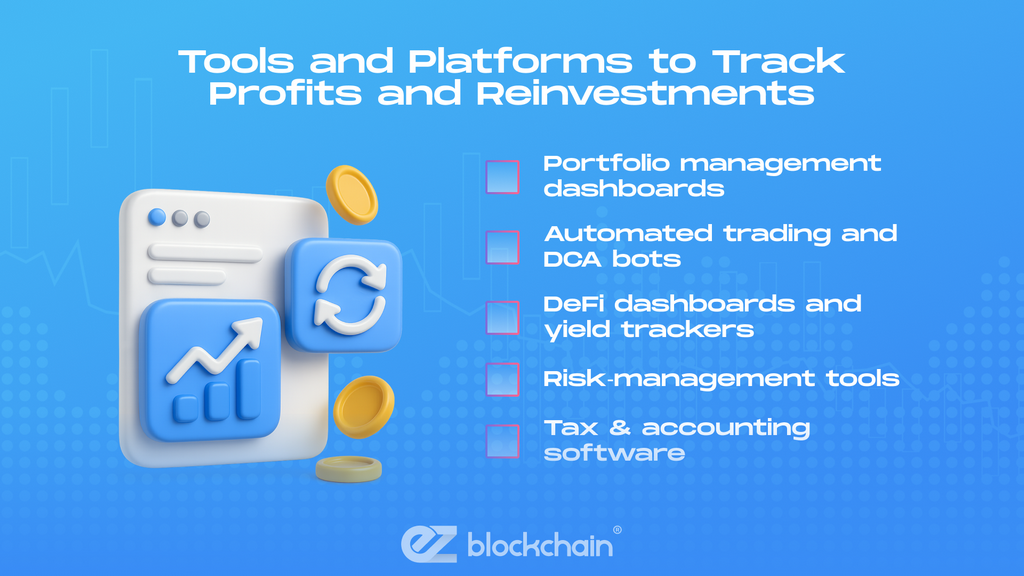
Efficient tracking and reinvestment require good tooling. Several platforms and tools help you monitor profits, manage allocation, and automate reinvestment:
A proper tech stack, combining data aggregation, automation, yield tracking, and accounting support, transforms a patchwork of trades into a disciplined, scalable investment operation.
Given crypto’s volatility and multi-faceted growth vectors, a diversified, compound‑oriented strategy often yields the most resilience. Below is a sample diversified reinvestment allocation model for 2026 (for illustrative purposes):
| Allocation Type | Share of Crypto Portfolio | Rationale / Purpose |
| Core assets (Bitcoin / top-cap altcoins) | 40–60% | Stability, liquidity, long-term value anchor |
| Yield-bearing assets (staking, DeFi) | 15–25% | Passive income + compounding yield |
| Mid-cap altcoins / thematic tokens (DeFi, infra) | 10–15% | Growth potential, higher upside |
| Small-cap / high-risk / speculative | 5–10% | High-risk/high-reward, small-size exposure |
| Stablecoins / fiat‑equivalents (cash buffer) | 5–10% | Liquidity buffer, re-entry capital, risk mitigation |
This mix balances stability (core + yield), growth potential (alts + staking), and liquidity/reserve (stablecoins + cash buffer).
Closing paragraph: Diversification doesn’t guarantee returns, but it significantly reduces tail‑risk, smooths volatility, and preserves optionality, giving you the flexibility to ride cycles, re-enter, or pivot as market structure changes.
| Workflow Stage | Action | Purpose / Benefit |
| Profit Realization | Sell predefined portion at target gain (e.g. +100%) | Lock in profit, secure gains before volatility spikes |
| Gains Calculation & Tax Provisioning | Compute net gain after fees, allocate for taxes | Avoid surprise tax liabilities, maintain compliance |
| Reallocation / Reinvestment | Deploy portion into core assets, yield positions, altcoins, stablecoins | Compound growth, diversify risk, maintain exposure |
| Yield Activation | Stake coins / provide liquidity / yield‑farm | Generate passive income during holding period |
| Automation & Monitoring | Use DCA bots, portfolio trackers, yield dashboards | Reduce manual workload, enforce discipline, monitor returns |
| Periodic Rebalancing | Quarterly or semi‑annual review & rebalance | Maintain target allocation, respond to market shifts |
| Reserve & Risk Buffer | Keep stablecoins/cash for liquidity and opportunistic entries | Protect against crashes, enable strategic buys |
This workflow turns profit-taking and reinvesting from a one-off gamble into a repeatable, managed investment process, with transparency, risk control, and compounding potential.
Crypto investing, especially in 2025–2026, is not just about “buy low, sell high.” It’s about building a systematic, disciplined, and resilient strategy that balances profit-taking with reinvestment, yield, risk control, and long-term value creation.
Key takeaways:
In short, treat your crypto portfolio like a multi‑asset, long-term financial project, not a speculative lottery ticket. By combining discipline, data-driven decision-making, yield strategies, and diversification, you can maximize the chances of sustainable growth while managing downside risk.
Fill out a form and our bitcoin mining expert will contact you.
FREE CONSULTATIONFill out a form and our bitcoin mining expert will contact you.


Use a tiered, rule-based approach rather than trying to “sell the top.” Common strategies include:
Allocation thresholds: Rebalance if a single asset exceeds a set portfolio percentage (e.g., 30–50%).
Before selling or swapping:
This ensures accurate net profit calculation and avoids unexpected tax liabilities.
Diversify across risk and return profiles:
Stablecoins: Hold for liquidity, dip-buying opportunities, or risk mitigation.