Count me in!
Stay up to date with the latest news, announcements, and articles.
Below are the primary, beginner-appropriate strategies for earning returns from Bitcoin. Each is followed by the mechanics, expected performance profile, and operational requirements.
The right choice depends on time horizon, available capital, tax status, and operational bandwidth. For most beginners, a mix of 60–80% passive allocation (DCA/HODL) and a small tactical sleeve for swing trades is the simplest effective portfolio.
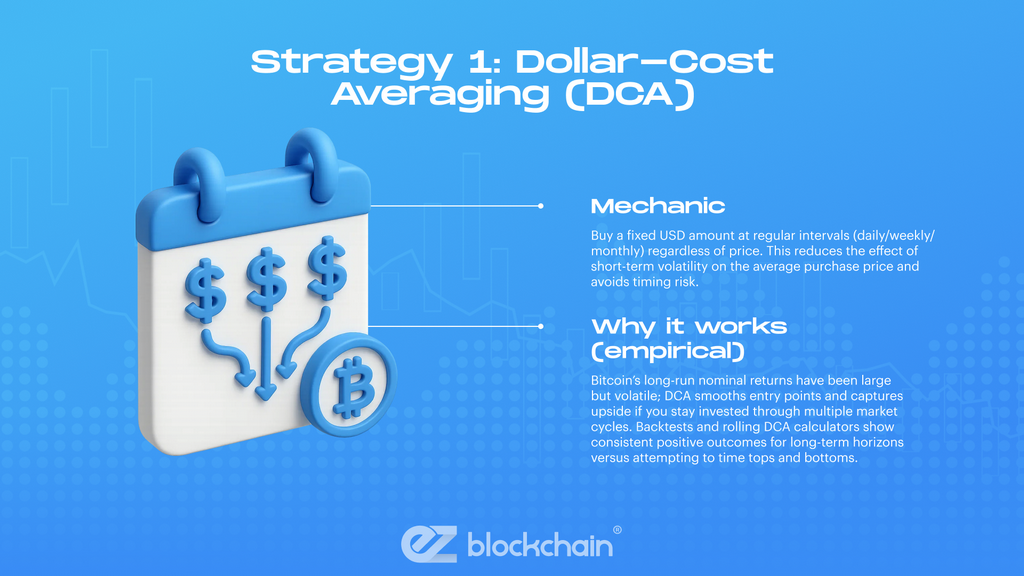
Mechanic. Buy a fixed USD amount at regular intervals (daily/weekly/monthly) regardless of price. This reduces the effect of short-term volatility on the average purchase price and avoids timing risk.
Why it works (empirical): Bitcoin’s long-run nominal returns have been large but volatile; DCA smooths entry points and captures upside if you stay invested through multiple market cycles. Backtests and rolling DCA calculators show consistent positive outcomes for long-term horizons versus attempting to time tops and bottoms .
Practical setup (execution-level):
Operational considerations: DCA is not tax-loss harvesting, maintain separate rules for tax optimization. If ETFs or custodial products are used, include management fees in your expected cost model.
DCA is the single highest-leverage strategy for beginners because it replaces timing skill with discipline; automate it, document cashflows, and treat the cadence as an immutable rule in your portfolio playbook.
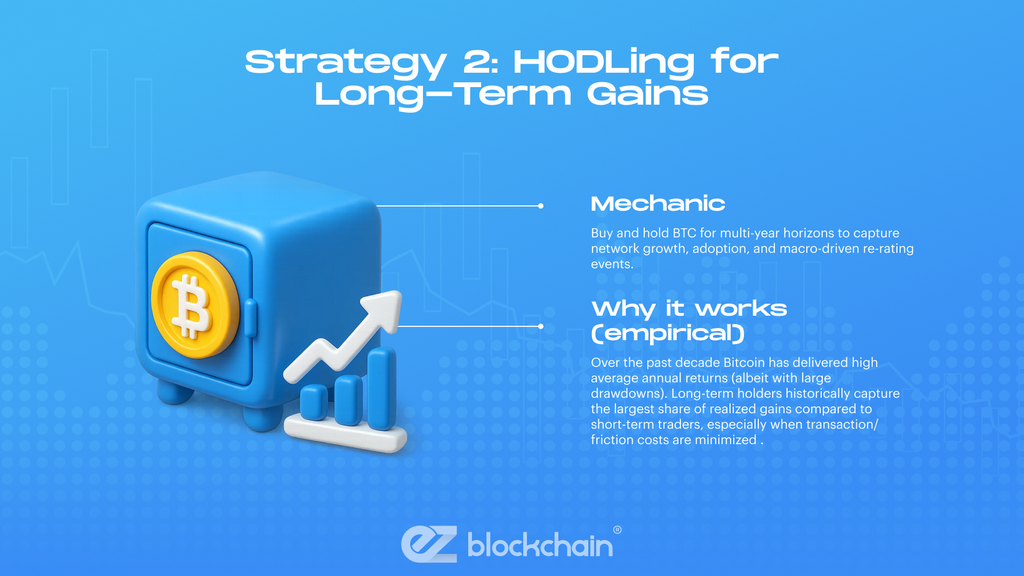
Mechanic. Buy and hold BTC for multi-year horizons to capture network growth, adoption, and macro-driven re-rating events.
Why it works (empirical): Over the past decade Bitcoin has delivered high average annual returns (albeit with large drawdowns). Long-term holders historically capture the largest share of realized gains compared to short-term traders, especially when transaction/friction costs are minimized .
Practical setup:
Operational considerations: Storage security is the primary operational risk. Also model mental accounting for drawdowns (e.g., 50–80% drops are within historical experience). Prepare a liquidity cushion in fiat to avoid forced selling during distress.
HODLing shifts the challenge from timing markets to managing custody risk and personal tolerance for volatility; if you can secure your keys and live through drawdowns, long-term compounding is the dominant path for beginners.
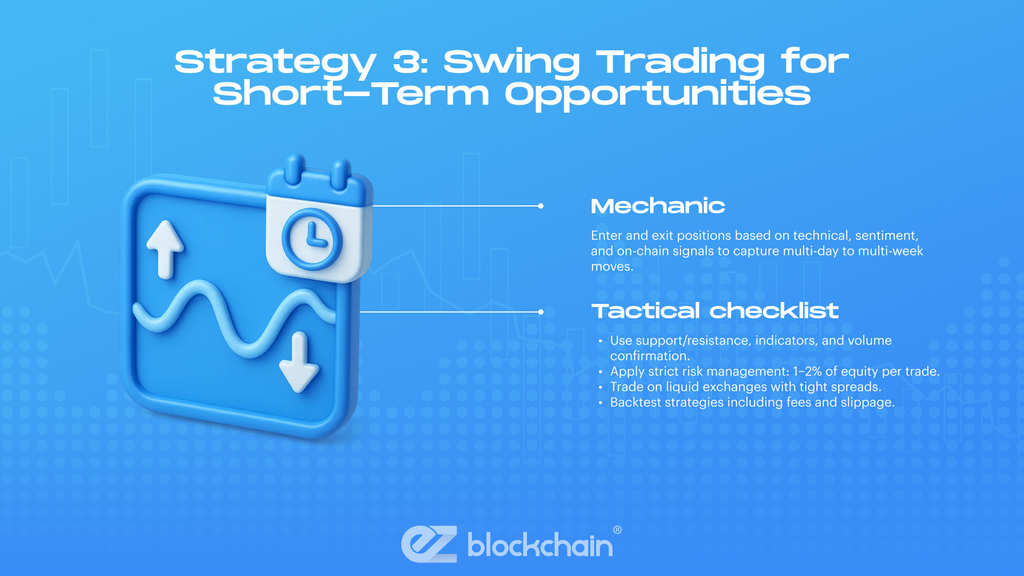
Mechanic. Enter and exit positions based on technical, sentiment, and on-chain signals to capture multi-day to multi-week moves.
Tactical checklist:
Benchmarks & risk: Bitcoin’s realized volatility can exceed 50% annualized; adjust position sizing accordingly. Active trading increases tax complexity and execution cost, model these explicitly into expected returns .
Swing trading can add alpha but requires disciplined process control, defined entries/exits, position-sizing rules, and a written trading plan; novices should limit active exposure to a small percentage of capital until they can consistently backtest and forward-simulate results.
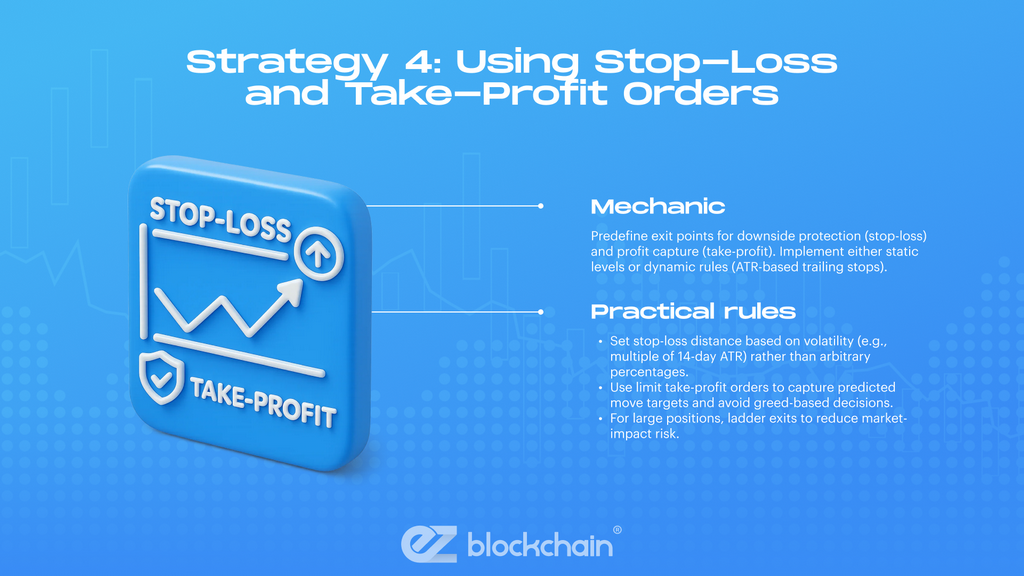
Mechanic. Predefine exit points for downside protection (stop-loss) and profit capture (take-profit). Implement either static levels or dynamic rules (ATR-based trailing stops).
Practical rules:
Operational considerations: Market gaps on sharp moves may cause stops to fill worse than expected; use limit orders where possible and monitor overnight risk if positions are held while you sleep.
Stop-loss and take-profit rules convert fuzzy risk attitudes into enforceable trading mechanics, critical for keeping losses bounded and compounding returns over many trades.
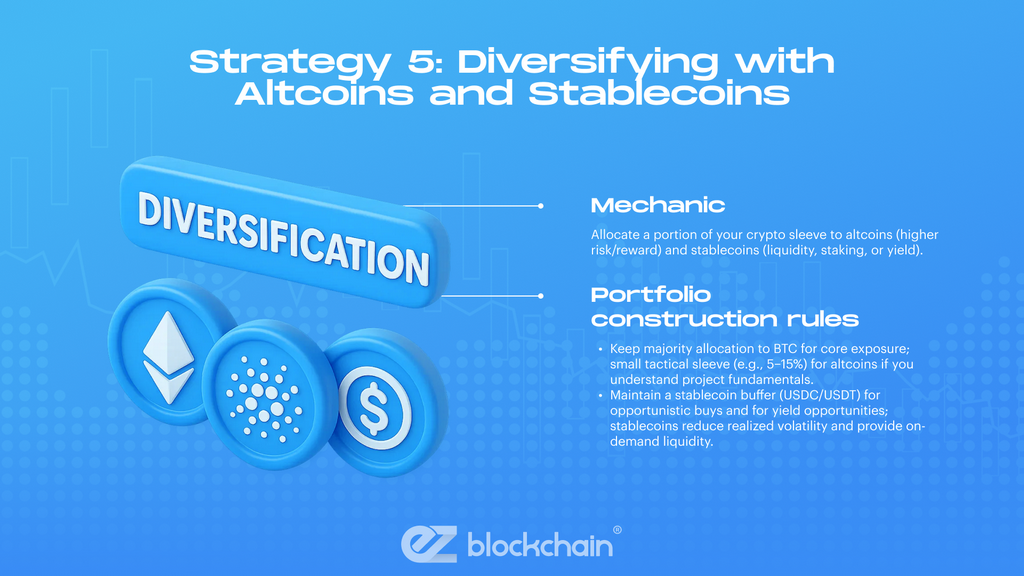
Mechanic. Allocate a portion of your crypto sleeve to altcoins (higher risk/reward) and stablecoins (liquidity, staking, or yield).
Portfolio construction rules:
Operational considerations: Altcoins increase idiosyncratic risk and smart-contract risk. Use due-diligence frameworks: tokenomics, developer activity, on-chain metrics, and active security audits.
Diversification beyond Bitcoin is optional for beginners and should be scaled to experience, stablecoins are a pragmatic first step to improve agility without materially increasing systemic portfolio volatility.
Effective risk management is where profitability becomes durable. Here is an ordered control framework you can implement immediately:
Closing paragraph: These controls are the backstop that converts profitable rules into sustainable gains, don’t skip them because “it’s inconvenient.”
Recommended tooling (practical stack):
Closing paragraph: Tool choice should prioritize custody/security first, then execution cost, then UX, cheap failures in custody are irrecoverable.
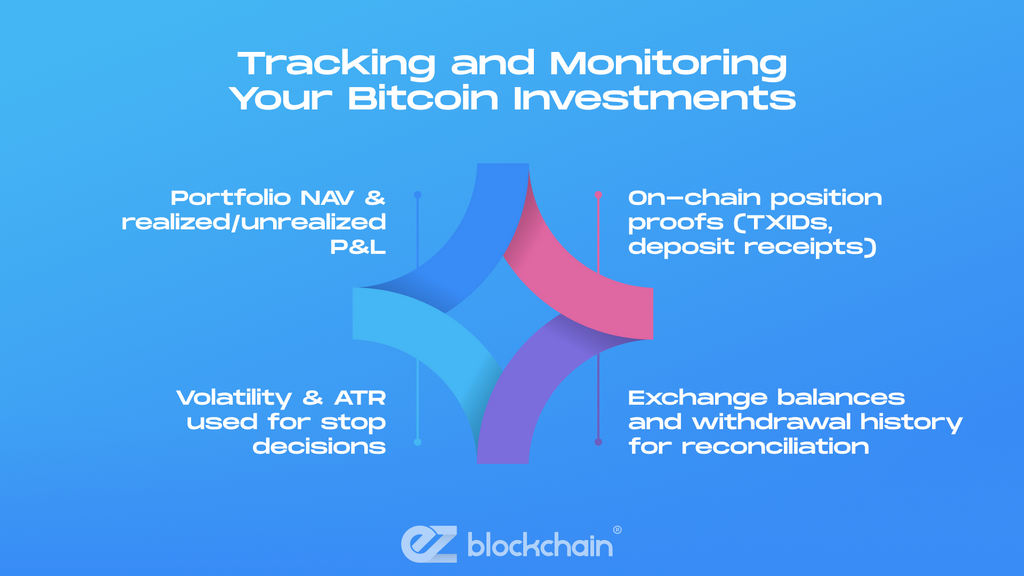
Implement an operations dashboard with these signals:
Closing paragraph: Monitoring turns an investment thesis into a controlled process, automating alerts for large drawdowns and unusual exchange activity.
Common novice errors (and how to avoid them):
Avoiding these mistakes is more important than finding the “perfect” strategy, the simplest methods executed consistently usually outperform complex strategies executed poorly.
| Strategy | Time Horizon | Skill Required | Typical Capital | Primary Risk |
| DCA | Long (yrs) | Low | Low–Medium | Market drawdowns |
| HODL | Long (yrs) | Low | Medium–High | Custody & volatility |
| Swing Trading | Days–Weeks | Medium–High | Medium | Execution risk |
| Stop/Take Orders | Any | Low–Medium | Any | Gapping/slippage |
| Altcoin/Stablecoin | Any | Medium | Low–Medium | Idiosyncratic/smart-contract |
Use this table to map your objectives to a strategy; beginners benefit from starting on the left column (DCA/HODL) and only introducing active tactics after establishing a secure custody baseline.
A practical beginner portfolio is simple: automate DCA into BTC for the core allocation, store the majority in cold storage, maintain a stablecoin liquidity buffer, and reserve a small tactical sleeve for swing trades or selective altcoins. Enforce position-sizing and stop rules, instrument monitoring, and reconcile monthly for taxes and auditability. Bitcoin’s volatility creates opportunity and risk in equal measure; the durable edge for beginners is disciplined process, strong custody, and a written plan.
Market backdrop notes: Bitcoin’s volatility remains materially higher than traditional assets, and institutional flows (ETF AUM, recurring purchases) materially influence liquidity and seasonality, incorporating these macro signals into rebalancing logic.
Fill out a form and our bitcoin mining expert will contact you.
FREE CONSULTATIONFill out a form and our bitcoin mining expert will contact you.