https://ezblockchain.net/article/bitcoin-investment-today-is-it-safe/
In 2025, with heightened institutional participation, evolving regulatory regimes, and macroeconomic headwinds, the question “is it safe to invest in Bitcoin today?” demands a rigorous assessment. This article provides a technical dive into Bitcoin’s current state, evaluates whether it remains a viable investment, analyzes stability factors, compares volatility with long‑term growth, addresses security of exchanges and wallets, examines institutional interest and regulatory implications, explores diversification strategies, presents expert risk‑management insights, and concludes with a clear framework for investors.
The State of Bitcoin in 2025
Bitcoin’s landscape in 2025 reflects both maturation and persistent complexity:
- Global crypto adoption in 2025 shows strong growth: according to the Chainalysis 2025 Global Adoption Index, North America saw crypto adoption grow by 49 % year‑on‑year, Europe by 42 %, and APAC by 69 %.
- Institutional engagement has accelerated: the EY 2025 Institutional Investor Digital Assets Survey indicates 59 % of surveyed asset managers plan to allocate over 5 % of assets under management (AUM) to digital‑assets.
- Long‑term forecasts suggest sustained growth: according to the Bitwise “Bitcoin Long‑Term Capital Market Assumptions 2025” report, Bitcoin is projected to exhibit a compound annual growth rate (CAGR) of ~28.3 % through 2035, with average annualised volatility around 32.9 %.
- Volatility remains elevated relative to many traditional assets, yet trending downward: the Fidelity Digital Assets review found Bitcoin’s volatility has declined, and at times is less than that of certain large‑cap stocks.
These data points suggest Bitcoin is evolving from a speculative fringe asset toward a more mainstream portfolio component—but “safe” remains relative, not absolute.
Is Bitcoin Still a Good Investment?
From a technical‑investment lens, the question “is Bitcoin a safe investment?” involves trade‑offs:
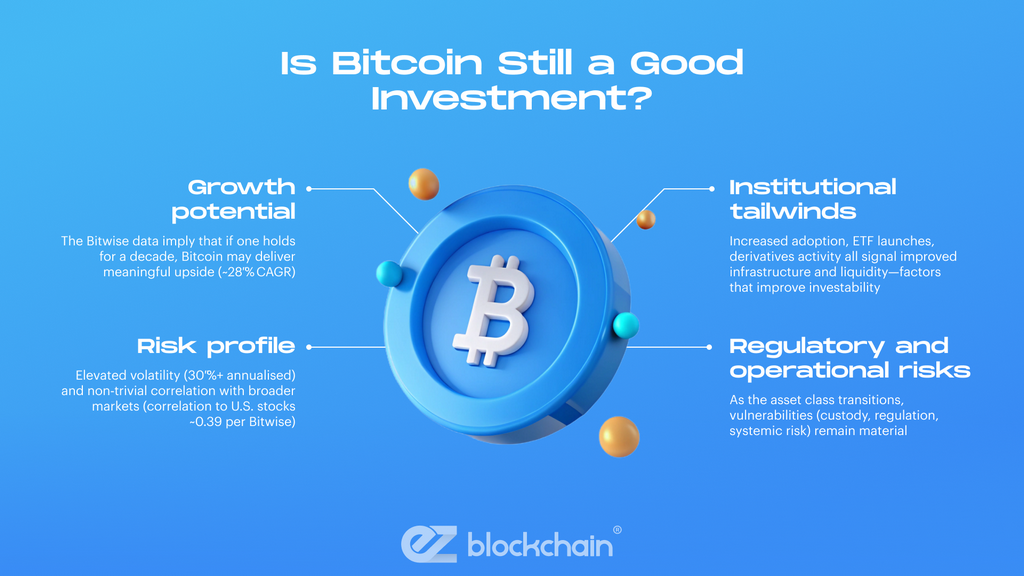
- Growth potential: The Bitwise data imply that if one holds for a decade, Bitcoin may deliver meaningful upside (~28 % CAGR).
- Risk profile: Elevated volatility (30 %+ annualised) and non‑trivial correlation with broader markets (correlation to U.S. stocks ~0.39 per Bitwise).
- Institutional tailwinds: Increased adoption, ETF launches, derivatives activity all signal improved infrastructure and liquidity—factors that improve investability.
- Regulatory and operational risks: As the asset class transitions, vulnerabilities (custody, regulation, systemic risk) remain material.
In sum: Yes, Bitcoin can still be a good investment—but only for investors who accept its risk‑profile, understand the infrastructure and regulatory environment, and place it within a broader diversified portfolio—not as a “safe” yield asset.
Factors Affecting Bitcoin’s Stability
Several technical and structural factors influence how stable—or unstable—Bitcoin might be:
- Supply‑cap and issuance mechanics: Bitcoin’s fixed supply (21 million coins) and scheduled halving events exert deflationary forces, but also introduce supply shocks which can amplify price swings.
- Volatility driver: Studies show Bitcoin remains far more volatile than traditional assets, even as volatility is trending lower. The BIS paper finds crypto‑assets’ volatility “dwarfs” that of stock/bond markets.
- Correlation with traditional assets: As adoption rises, Bitcoin’s correlation with equities increases, reducing its diversification benefit in a portfolio. Bitwise cites ~0.39 correlation to U.S. stocks.
- Exchange / wallet infrastructure and custody risk: Security failures (exchange hacks, wallet mis‑management) remain real and can introduce idiosyncratic risk.
- Regulatory environment: Clarity and enforcement across jurisdictions affect investor confidence, permissible product formats (ETFs, custodial services) and ultimately market stability.
- Liquidity and market depth: Deep institutional derivatives markets (for example, high open interest in Q3 2025) reduce execution risk and slippage.
Thus, stability is not simply about lower price swings but about robust infrastructure, regulatory clarity, liquidity, and systemic integration.
Volatility vs Long‑Term Growth
Understanding the interplay between volatility and long‑term growth is key to “is it safe to buy Bitcoin” analysis.
Empirical data:
| Metric |
Value (2025 estimate) |
| Estimated CAGR (to ~2035) |
~28.3 % |
| Average annualised volatility |
~32.9 % |
| Correlation to U.S. equities |
~0.39 |
Interpretation:
- High volatility means that year‑to‑year returns will swing widely—both up and down.
- A long time‑horizon (5‑10 years+) increases the probability the long‑term growth thesis materialises.
- For shorter‑term investors, the volatility risk may outweigh the growth potential, especially if they cannot tolerate downside draw‑downs.
- Volatility has been trending downward, which could improve the risk‑return trade‑off for investors over time.
The long‑term growth potential is meaningful, but the volatility means it is not safe in the sense of low‑risk assets. It can be relatively safer if held as a small portion of a diversified portfolio with a long horizon.
Security of Exchanges and Wallets
Technical security and custodial architecture are foundational to the “safest way to invest in Bitcoin”.
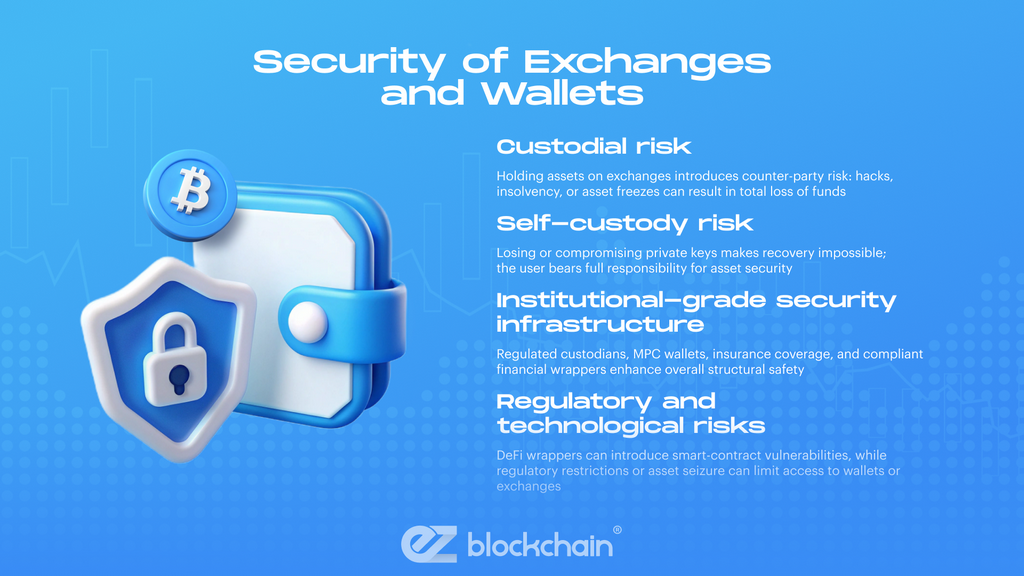
- Custodial risk: Exchanges holding user assets pose counter‑party risk. A hack or insolvency (as previously seen) can wipe investor wealth.
- Self‐custody risk: Private keys lost, stolen or mis‑managed mean irreversible loss.
- Institutional infrastructure: The growth of regulated custodians, multi‑party computation (MPC) wallets, insurance coverage, and regulated product wrappers improve structural safety.
- Smart‑contract risk: While Bitcoin is mostly UTXO‑based and less reliant on smart contracts than other assets, ecosystem wrappers (for example for DeFi) may introduce additional layers of risk.
- Recovery/regulatory risk: In some jurisdictions, access to wallets or exchanges may be constrained by regulation or seizure risk, affecting “is Bitcoin safe”.
Concluding statement: Security in Bitcoin investing depends not only on the coin itself, but on how you hold it, where you hold it, and which counterparties you outsource to. Proper architecture reduces risk materially.
Institutional Interest and Regulations
Institutional participation and regulatory regimes are reshaping Bitcoin’s investment landscape.
- ETF and derivatives growth: For example, derivatives open interest reached record levels (average daily open interest ~$31.3 billion in Q3 2025).
- Regulatory clarity: Many jurisdictions are crystallising rules for crypto‑assets, making institutional entry more predictable, which generally improves risk profile.
- Institutional allocation: The EY survey shows 59 % of institutions plan to allocate >5 % of AUM to digital assets.
- Macro‑policy interplay: Because Bitcoin is increasingly integrated with financial markets, regulation, tax policy, and macro‑prudential frameworks will shape its risk profile.
Increased institutional adoption and regulatory maturity enhance the safety profile of Bitcoin investing by improving infrastructure, oversight and liquidity—but they do not eliminate fundamental risks.
Diversification Strategies for Investors
Integrating Bitcoin into a diversified portfolio is essential if you are asking “is it safe to invest in Bitcoin”.
- Limit exposure: Rather than allocate large portions, many portfolio‑theory frameworks suggest 1 %–5 % of investable assets may give upside participation with manageable risk.
- Combine with other assets: Use Bitcoin as one component—alongside equities, bonds, real‑assets—to reduce idiosyncratic risk.
- Time‑horizon alignment: Match the holding period of Bitcoin with your investment horizon—shorter horizons amplify risk due to volatility.
- Regular rebalancing: When Bitcoin’s allocation drifts above target due to price run‑up, consider trimming to maintain risk profile.
- Custody diversification: Use multiple wallets/custodians to spread operational risk.
Diversification doesn’t make Bitcoin fully safe—but it helps integrate it as a measured risk/return asset, not a speculative play.
Expert Insights on Risk Management
Several technical research reports give insight into how to manage risk when investing in Bitcoin:
- A 2025 study of Bitcoin and Ethereum volatility (“Exploring volatility reactions…”) found that crypto price volatilities are responsive to macroeconomic data releases (U.S., Germany, Japan) and that volatility remains elevated when macro data surprises occur.
- The Fidelity piece “A Closer Look at Bitcoin’s Volatility” argues that while Bitcoin remains volatile, its relative volatility has improved and historically investors have been compensated for assuming the risk.
- On the technology/security front, the literature on “Periodicity in Cryptocurrency Volatility and Liquidity” found that volatility and liquidity patterns have become more structured, which enhances predictability to some extent.
Experts agree Bitcoin carries meaningful risk—but improved infrastructure, data‑driven volatility models and institutional frameworks are enabling more sophisticated risk‑management than earlier cycles.
Conclusion
So, is it safe to invest in Bitcoin today? The short answer: it depends. If you require low‑risk, stable returns and cannot tolerate major draw‑downs, then Bitcoin is not safe in the traditional sense. But if you understand its risk‑return profile, allocate only a modest portion of your portfolio, secure your holdings properly, and maintain a multi‑year horizon, then Bitcoin can be a relatively viable growth‑oriented asset.
Key take‑aways:
- The ecosystem is maturing (institutional flows, regulatory clarity), which improves investability.
- Volatility remains high but trending lower; long‑term growth models (CAGR ~28 %) are favourable.
- Security and custodial risks persist; infrastructure choices matter.
- A diversification mindset and robust risk‑management framework are essential.
In technical terms: treat Bitcoin as an alpha‑oriented asset within a broader portfolio—not as a safe‑haven or risk‑free investment. With appropriate structuring and horizon, you can participate in its upside while managing the attendant risks.
HOST YOUR MINERS WITH EZ!
Fill out a form and our bitcoin mining expert will contact you.
FREE CONSULTATION
Help me
choose
a miner
How to calculate
profit and
understand data?
How to setup mining
business remotely
with EZ Blockchain?
FREE CONSULTATION
Fill out a form and our bitcoin mining expert will contact you.