Count me in!
Stay up to date with the latest news, announcements, and articles.


And this paradigm shift seems to be moving faster by the day:
Crypto lobbying by authorities and big investors is a new trend that gains more momentum after every other crypto-related announcement by Washington. What is it, what drives it, and how crypto lobbying won over Trump? Let’s take a look.
Crypto lobbying is when companies, industry groups, and stakeholders in the crypto and blockchain space start influencing major digital asset decisions. For instance, big crypto holders can impact the regulation, legislation, and public policies covering today’s cryptos. But there’s a big difference between lobbying and simple grassroots activism or public campaigns.
The lobbying involves:
In practice, this means crypto firms and associations communicate with Congress, regulatory agencies, and government officials to push for crypto laws. The lobbying focus is put primarily on the laws that:
“What happens in Washington easily reverberates globally” — EZ Blockchain
As crypto becomes more mainstream and complex, lobbying has become its inherent strategic tool that doesn’t simply keep crypto above the water — it supports the industry innovation, institutional adoption, and long-term growth.
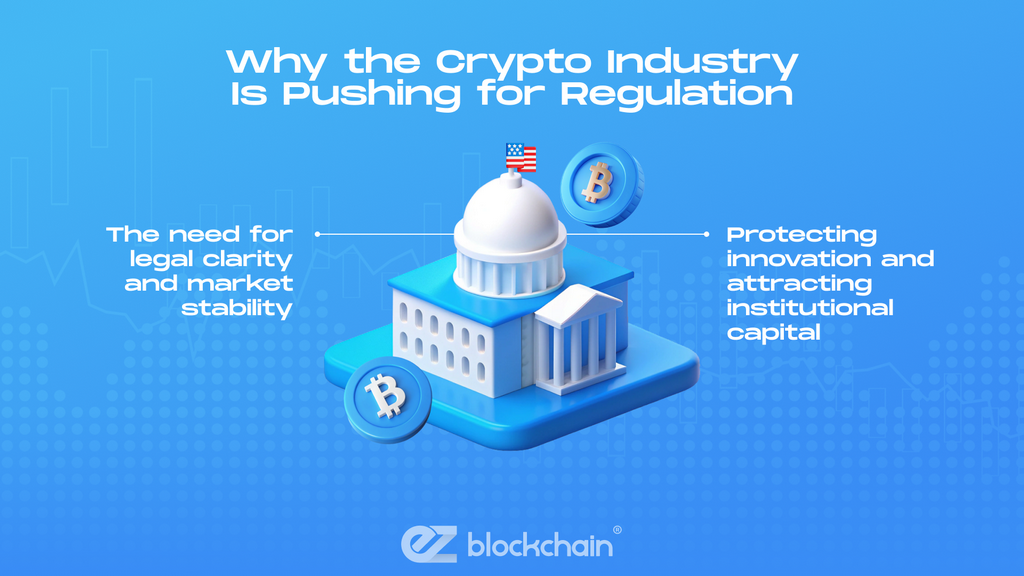
Understanding how crypto lobbying works is simpler when you know the core reasons why it is done in the first place. We can break it down into two ultimate reasons:
One of the main motives behind the jump in crypto lobbying is the lack of consistent, clear regulatory rules in many jurisdictions — especially the United States. For many stakeholders, the ambiguous status of cryptocurrencies, stablecoins, and tokenized products is a risky obstacle.
It prevents them from accumulating institutional capital, adopting crypto more broadly, and growing crypto portfolios stably.
The industry hopes to turn things around and get rid of grey zones and uncertainties in crypto regulations by influencing its overall legislation. We need more legal clarity and reliability before we remove risks and legal challenges for firms, investors, and consumers altogether.
Crypto is a rapidly evolving sector where innovation tends to outpace regulation. There are many companies developing DeFi systems, stablecoins of their own, smart-contract platforms, and tokenized infrastructures. But they need some breathing room to experiment and deploy new products, which regulatory uncertainty can stifle.
Alternatively, a favorable regulatory environment draws in new investments, attracts large financial institutions to enter the space, and supports development of new blockchain-based services. Lobbying thus serves not just to defend existing business models — but to build a foundation for future growth, institutional trust, and mainstream adoption.
There are several big groups advocating lobbying in the USA. These are the main drivers of increased crypto lobbying over Trump’s previously overly-stifling policies.
First off, there’s the official Blockchain Association — a trade group representing crypto interests in Washington. This group acts as a unified voice for multiple firms, advocating for:
But the main mission of the Blockchain Association is to “pool” various influences and align common goals of other companies interested in lobbying — all to amplify the impact of lobbying efforts.
Beyond official authorities, major crypto firms have also stepped up their lobbying budgets. For instance, one of the go-to crypto platforms, Coinbase, increased its lobbying spending from roughly $80,000 in 2017 to about $2.86 million in 2023 (a 3,475% boost!).
Similarly, Binance.US, another huge and well-known platform, expanded its lobbying spending from around $160,000 to about $1.215 million in the same period.
Other firms — stablecoin issuers, DeFi platforms, institutional investors, etc. — also contribute, but it’s difficult to analyze their impact in figures. But we see enough activity to understand that lobbying is no longer the domain of a few large exchanges. Rather, it is an industry-wide effort to shape regulation.
Over recent years, lawmakers have started jumping in. With increasing lobbying expenditures, regulators and Congress now engage more seriously with the idea of crypto-specific legislation.
The growing recognition of digital assets is also reflected by frequent hearings, draft bills, and proposals dedicated to the topic. reflect growing recognition that digital assets require tailored frameworks — particularly around stablecoins, consumer protection, taxation, and the classification of tokens.
However, such assets still require tailored frameworks for managing stablecoins, protect consumers, tax crypto properly, and classify tokens on a legal level. That said, many lawmakers keep cautious. Lobbying has opened the door to meaningful discussion. But broader reform is still hindered by political, regulatory, and macroeconomic uncertainties.
Bottom line, the lawmakers are seeking a delicate balance — they are aware of the pressing need for more clarity, but stay wary of existing risks.
Based on all the takeaways we have, cryptocurrency and digital assets in general should have a very dynamic period. If everything keeps turning in crypto’s favor, we should see:
Lobbying is only part of the crypto industry’s influence strategy. Political donations are what should boost its reach. Such donations are commonly routed from Political Action Committees and Super-PACs. Other entities affiliated with the industry can also back pro-crypto candidates, contributing to the momentum.
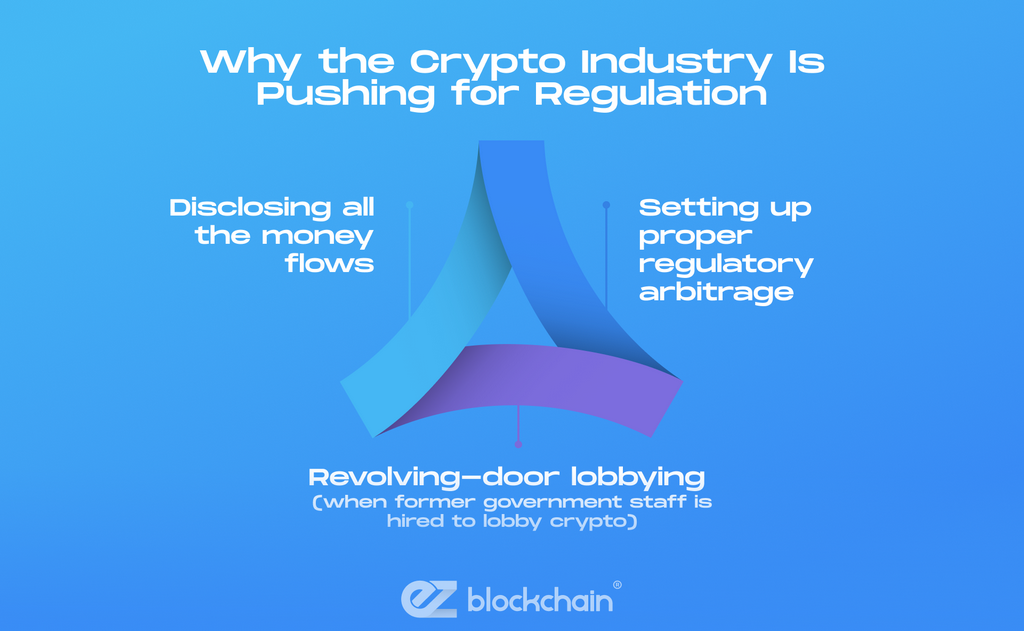
Now, because many donations go through PACs or intermediaries, tracing the true influence and money behind lobbying becomes quite difficult. The challenge lies in:
This makes finance reports opaque. Potentially, it can lead to a system where large crypto firms shape laws to their advantage. This is one of the main future challenges we are yet to handle.
What happens in Washington easily reverberates globally. U.S. crypto policy is shaped in part by crypto lobbying, which in turn influences regulatory thinking and frameworks worldwide. Countries that follow and watch U.S. developments may adopt similar approaches.
As such, the overall success of crypto lobbying in the U.S. can have ripple effects. This includes the influence over international standards, increase in cross-border investments, and fuller perception of crypto legitimacy as a whole.
On top of that, if U.S. regulators adopt clear, balanced frameworks, it could pave the way for institutional capital globally, finally making crypto a mainstream asset class. For now, crypto lobbying won some space — we’ll see where it takes us soon.
Got more questions about the latest crypto policies? Talk to EZ Blockchain’s experts for more industry insights, consultation of crypto operations, and purchase/hosting of ASIC miners.
Fill out a form and our bitcoin mining expert will contact you.
FREE CONSULTATIONFill out a form and our bitcoin mining expert will contact you.


Crypto lobbying is when cryptocurrency companies, trade associations, and related organizations gain influence over government policies, regulations, and legislations. The influence that may affect entire digital-asset markets. The process of lobbying usually includes meeting with crypto-minded lawmakers, funding crypto advocacy efforts, promoting crypto-favorable laws, and building regulatory frameworks.
The industry seeks clear, predictable regulation of crypto to replace the regulatory uncertainty that hinders its global adoption right now. The biggest hope is to achieve the desired legal clarity and overall market stability. In conditions like that, crypto can finally go mainstream, innovate further in a legally protected environment and satisfy institutional investors.
Some of the most active groups include Blockchain Association — a trade-association acting on behalf of multiple crypto firms pushing the lobbying sentiment. Apart from that, all major exchanges and firms involved with crypto, such as Coinbase and Binance, all drive the lobbying. Reportedly, these groups invest millions on lobbying and advocacy to influence U.S. crypto policies.
The lobbying spending is on a major upward momentum: some reports show a multi-hundred percent increase over the past several years. For example, in a recent cycle, crypto lobbying in the U.S. reached record levels. Among non-authority lobbyists, Coinbase is the biggest investor, putting over $3 billion into various lobbying efforts in 2025.