https://ezblockchain.net/article/should-i-sell-bitcoin/
Deciding “should I sell my Bitcoin now” is far from a superficial choice—especially given that the flagship cryptocurrency Bitcoin (BTC) now behaves more like a hybrid asset: part speculative, part institutional‑grade portfolio instrument. When you ask “should I sell bitcoin”, you need a rigorous framework: market trends, tax implications, your own portfolio strategy, and clear sell‑criteria. In this article we explore why people sell, examine current market data, compare short‑ vs long‑term strategies, assess tax consequences, identify when selling makes sense (and when it doesn’t), look at alternatives to selling, survey expert views, and highlight tools for monitoring performance.
Why People Consider Selling Bitcoin
There are multiple valid motivations for contemplating a sale of Bitcoin:
- Realising profit: if your cost‑basis is far below the current price, you might choose to lock in gains rather than risk a draw‑down.
- Liquidity/personal use: you may need cash for non‑crypto investments, business capital, or personal needs—thus converting Bitcoin to fiat becomes a logical step.
- Re‑balancing risk: if Bitcoin has grown to represent too large a share of your portfolio, selling can restore your allocation strategy.
- Hedging macro/regulatory risk: if cryptocurrency regulation is tightening, or a macro event looms, you may sell to avoid exposure.
- Loss‑harvesting or tax‑planning: selling may generate a tax loss or trigger capital gains in a judicious manner, depending on jurisdiction.
The decision to sell should be driven by objective criteria—profit‑targets, liquidity needs, portfolio tolerance—rather than reactive emotions.
Analyzing Current Market Trends
When we ask “when to sell crypto” and specifically “best time to sell Bitcoin”, the current market context matters.
On‑chain / institutional data
A recent academic study found BTC’s correlation with major U.S. equity indices (e.g., the S&P 500, Nasdaq‑100) peaked at ~0.87 in 2024, signalling that Bitcoin is increasingly moving with traditional financial markets rather than serving as a pure hedge. This means macro shocks or equity downturns may hit Bitcoin harder than in earlier cycles.
Price‑trend and technical signals
- According to data published in November 2025, Bitcoin has been trading in a broad ~$588 billion value range since June, despite remaining above ~$100k. The report noted that this large range may mask market vulnerabilities.
- Forecasts vary: some models project Bitcoin may reach ~$120,000–$200,000 in 2025 under favourable conditions.
- On the flip side, some analysts warn of a potential drop toward ~$70,000–80,000 as part of a longer correction through late 2026.
Implication for selling decisions
Because Bitcoin’s behaviour is now strongly correlated with broader markets, timing becomes more critical. For instance, if equities fall, Bitcoin may fall too—thus prompting a sell‑decision might make sense prior to a macro shock. Conversely, if you believe institutional adoption and network fundamentals are intact, holding may be justified.
Short‑Term vs Long‑Term Holding Strategies
Your time horizon dramatically shifts the “when to sell” calculus.
Short‑Term Holding
- Objective: exploit tactical price moves, realise gains within weeks or months.
- Advantages: you can respond to technical breakouts, macro events, or liquidity needs.
- Risks: high market‑timing risk—selling too early may forgo upside; selling too late may crystallise losses.
Long‑Term Holding
- Objective: hold for years, based on belief in the structural thesis of Bitcoin (scarcity model, institutional adoption, digital‑gold narrative).
- Advantages: you allow time for the thesis to mature, avoid short‑term noise, potentially benefit from larger gains.
- Risks: draw‑downs may be deep and prolonged; the “best time to sell” window may slip away.
You must define your horizon before you ask “should I sell my Bitcoin now”. Without that anchor, you risk making an ill‑timed decision.
Tax Implications of Selling
Taxation is a non‑negligible component of the decision process—especially when converting crypto to fiat.
- In the U.S., selling cryptocurrency is a taxable event: capital gains tax applies on profit (cost‑basis vs sale price). Losses may offset gains and a portion of ordinary income.
- In other jurisdictions (e.g., Poland), crypto disposal may incur a flat capital‑gains tax (e.g., 19 %) or other regulatory rules.
- Realising gains early vs deferring them may have strategic implications (e.g., lower tax rate, offsetting losses, shifting into a lower bracket).
- Tax timing can influence when to sell Bitcoin: year‑end selling may be used for tax‑loss harvesting; immediate selling may trigger immediate tax liability.
Tax effects should not be an afterthought—they can materially alter the net benefit of selling.
When Selling Might Make Sense
There are concrete scenarios where selling Bitcoin is the rational move:
- You have achieved a profit target (say 2× or 3× your cost basis) and wish to lock in gains.
- You require liquidity for business/personal use which cannot easily wait.
- Your exposure to Bitcoin has grown beyond your risk appetite (e.g., > 10 % of your investable assets).
- You perceive a technical breakdown (e.g., major support is lost) or macro/regulatory risk is acute.
- You prefer to redeploy into another asset class or a hedged allocation rather than hold pure crypto.
Note: Selling is not a failure—it can be a strategic step when it aligns with your defined objective and risk‑frame.
Risks of Panic Selling
In contrast, selling simply out of fear or short‑term volatility may carry downsides:
- You may lock in losses at the bottom of a cycle and miss the recovery.
- Emotional decisions often lead to sub‑optimal timing (selling at a low, buying back at a high).
- Tax and transaction costs may erode the advantage of selling prematurely.
- Lack of strategy discipline may undermine your long‑term returns.
Panic selling is rarely optimal. Better to have predefined triggers and rational logic than reactive fear‑based decisions.
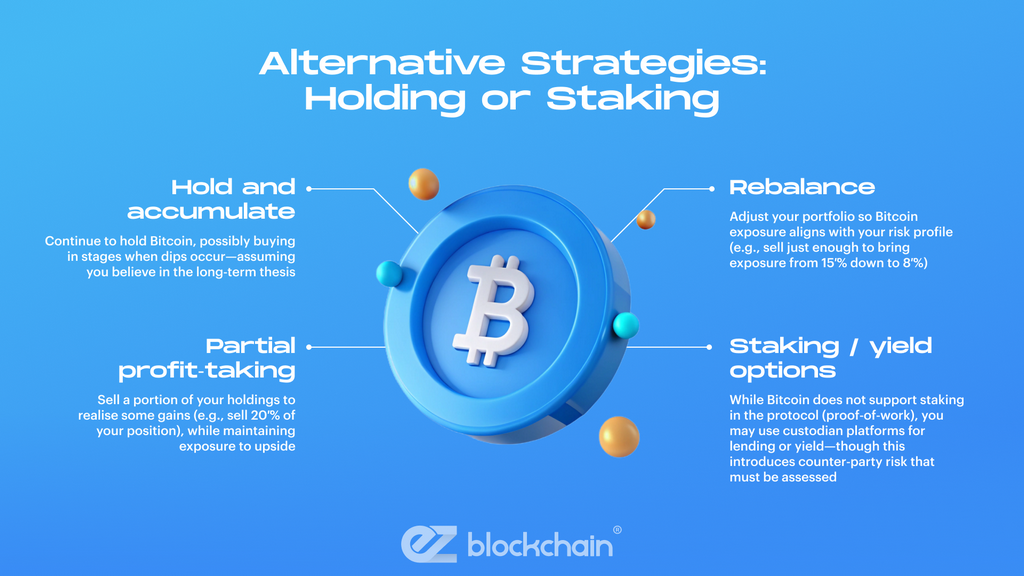
Alternative Strategies: Holding or Staking
Rather than outright selling, you can consider alternatives that preserve exposure while managing risk.
- Hold and accumulate: Continue to hold Bitcoin, possibly buying in stages when dips occur—assuming you believe in the long‑term thesis.
- Partial profit‑taking: Sell a portion of your holdings to realise some gains (e.g., sell 20 % of your position), while maintaining exposure to upside.
- Rebalance: Adjust your portfolio so Bitcoin exposure aligns with your risk profile (e.g., sell just enough to bring exposure from 15 % down to 8 %).
- Staking / yield options: While Bitcoin does not support staking in the protocol (proof‑of‑work), you may use custodian platforms for lending or yield—though this introduces counter‑party risk that must be assessed.
Selling isn’t binary. You can adopt hybrid strategies to balance upside potential and risk mitigation.
Expert Opinions and Predictions
When asking “should I sell my crypto”, expert views provide context—even if they are not guarantees.
- Many analysts expect Bitcoin’s price in 2025 to land in the ~$120,000–$200,000 range under favourable conditions.
- Some bearish scenarios forecast a drop toward ~$70,000–$80,000 in 2025‑26 if adverse conditions prevail.
- A 2025 prediction model projects Bitcoin reaching an average of ~$136,822 in 2025 (min ~$109,789, max ~$163,854) under certain assumptions.
Key takeaway: Expert predictions show wide ranges, which illustrates the large uncertainty. If your portfolio cannot tolerate such uncertainty, selling may make sense.
To make a sell‑decision you can credibly support, deploy analytical and monitoring tools:
- On‑chain analytics: monitor net accumulation by long‑term holders, exchange inflows/outflows, distribution of UTXOs.
- Technical indicators: moving averages (e.g., 200‑day MA), Relative Strength Index (RSI), support/resistance zones. For example, one analysis noted that Bitcoin’s 200‑day MA was recently sloping upward, but short‑term moving averages were turning bearish.
- Sentiment and machine‑learning: a study found that a context‑aware language‑model forecasting system achieved ~89.6% accuracy on substantial Bitcoin‑news events.
- Portfolio‑risk tools: track crypto’s share of your total assets, simulate “sell” vs “hold” scenarios, model net returns after tax & transaction costs.
Use measurable, repeatable tools—not just gut‑feel—to trigger your sell‑decision and avoid ad‑hoc swings.
Conclusion
So, “should I sell Bitcoin now?” is not a question with a universal answer. It depends on your time horizon, risk tolerance, portfolio context, tax situation, and what you expect from Bitcoin. If your goal is cashing out gains, reducing risk, or reallocating capital, then selling now may be justified. If you believe in the structural upside of Bitcoin and can tolerate draw‑downs, then holding or partial sale may be the smarter strategy. Whichever path you choose, anchor it in clearly defined criteria—profit target, risk threshold, tax plan—not headlines or emotional reactions.
The best time to sell Bitcoin is when you know why you’re selling, understand the alternatives, and have set clear‑cut triggers for execution. That disciplined approach will serve better than chasing market noise.
HOST YOUR MINERS WITH EZ!
Fill out a form and our bitcoin mining expert will contact you.
FREE CONSULTATION
Help me
choose
a miner
How to calculate
profit and
understand data?
How to setup mining
business remotely
with EZ Blockchain?
FREE CONSULTATION
Fill out a form and our bitcoin mining expert will contact you.