Count me in!
Stay up to date with the latest news, announcements, and articles.
With deep cross-integrations of the blockchain architecture and AI, you can use autonomous agents, gain access to decentralized data markets, and leverage compute networks. But there’s more. This novel match may be among the main drivers of Web3 currencies.
But how does it work, what do we need AI coins for, and what are the best AI crypto coins to use? Let’s go through the ins and outs of AI cryptocurrency, see how exactly such coins can be leveraged today, and what you should expect in return for mining one.
AI-based cryptos were born out of an experiment — integration of certain artificial intelligence features with a blockchain infrastructure. However, this time around, AI was embedded directly into the blockchain protocol and application layer.
This has opened a new horizon of capabilities and automations. You can only use your regular crypto token to stake, govern, or pay for something with it. A token with AI at its core, in turn, can be employed for more operations, all of which can be made autonomous.
“While looking at some tangible advantages, the AI-crypto space also faces significant challenges and risks.”
An AI coin thus can power an independent agent or node, which would use machine learning and smart decision-making algorithms to complete custom tasks. Such agents/nodes can interact with each other and other systems daily, and you don’t need to supervise them.
But that’s only one method — there are more described below. To sum up, AI alt coins can easily expand the blockchain as we know it beyond its role as just a ledger. It has already proven to be a fruitful space for decentralized intelligence projects.
Now, we went over some technology background, but to understand the specifics, let’s take a look under the hood, at the key mechanisms explained with real-world examples:
These are, by far, the most relevant and promising implementations of AI in crypto environments. This brings us to the next question — what is the best AI crypto to put at the core of such implementations?
Different types of AI coins can have diverse utilities. Here are the top 4 AI crypto coins that can help launch a new decentralized AI project today.
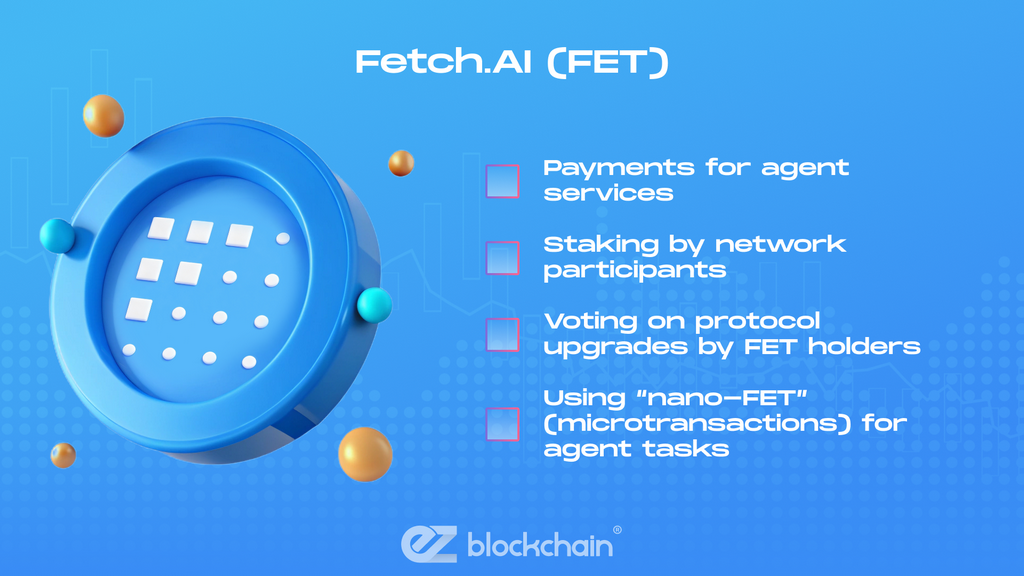
Fetch.AI is a complete network of autonomous economic agents, which facilitates the instant access to and use of AEAs for custom goals. The network houses ML-powered AEAs that can be managed via the AI Engine that translates your goals into multi-agent workflows.
The network’s dedicated token FET can be used for:
Fetch.AI runs on a uPoW — a useful Proof-of-Work consensus, which enables nodes to validate transactions while also contributing to AI workloads.
Best used for: Supply chain optimization, IoT, mobility, DeFi, and energy markets.
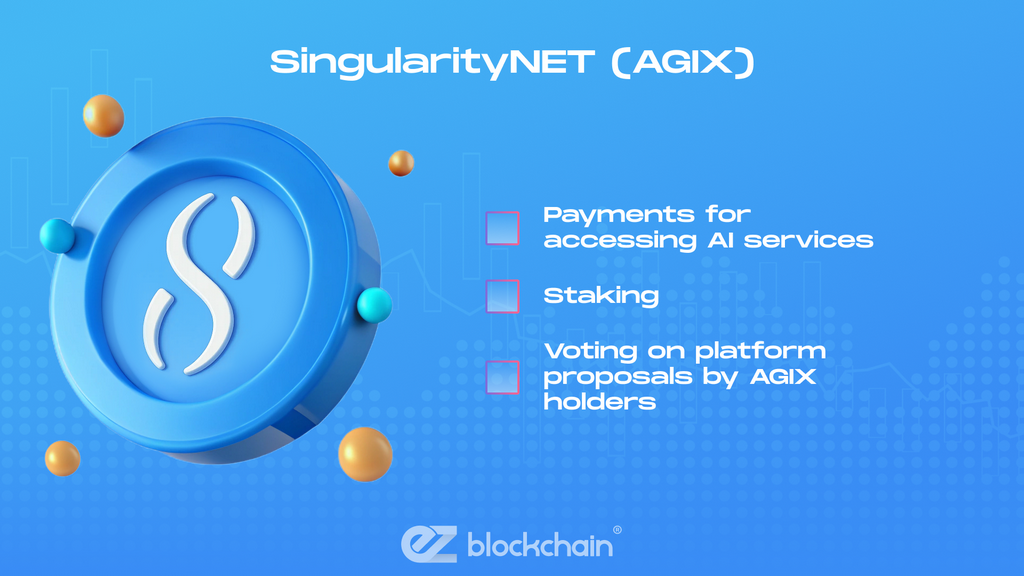
SingularityNET is a vivid example of a decentralized marketplace for third-party AI services. Developers publish AI services, usually models and algorithms, users pay to use them. The project promotes the next level of contextual sensitive AI — Artificial General Intelligence.
The platform’s AGIX token’s utility includes:
SingularityNET is interoperable, which means it works cross-chain and can be used for Ethereum and Cardano projects. It’s also integrated with other projects, like Ocean Protocol for data sharing.
Best used for: Projects with long-term vision toward AGI.
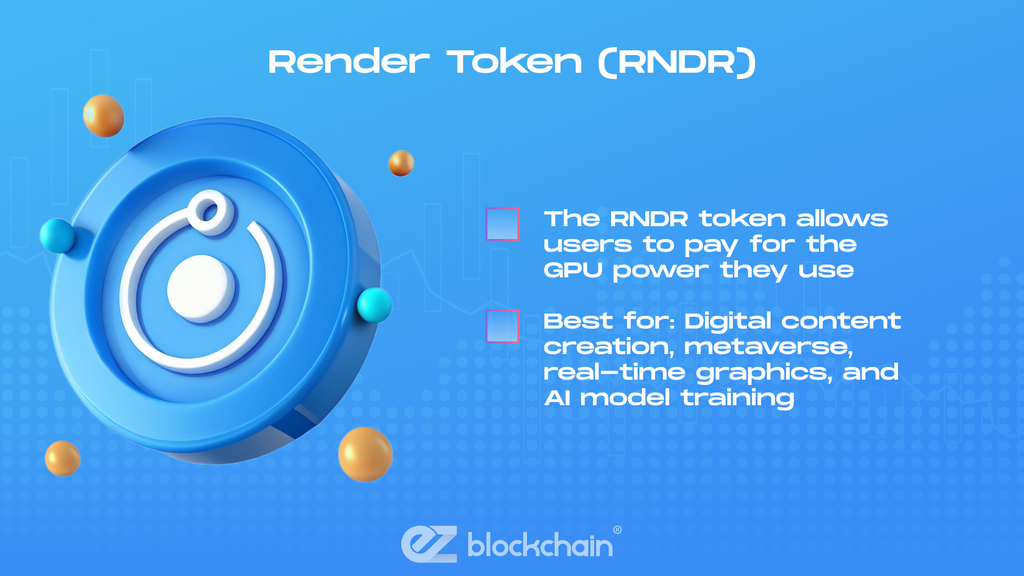
A decentralized GPU rendering network, Render Token is a novel platform that gathers GPU computing powers and provides them for external rendering tasks as well as AI training and inference.
The RNDR token allows users to pay for the GPU power they use. The providers of that power — the GPU owners — earn RNDR for contributing.
Best for: Digital content creation, metaverse, real-time graphics, and AI model training.
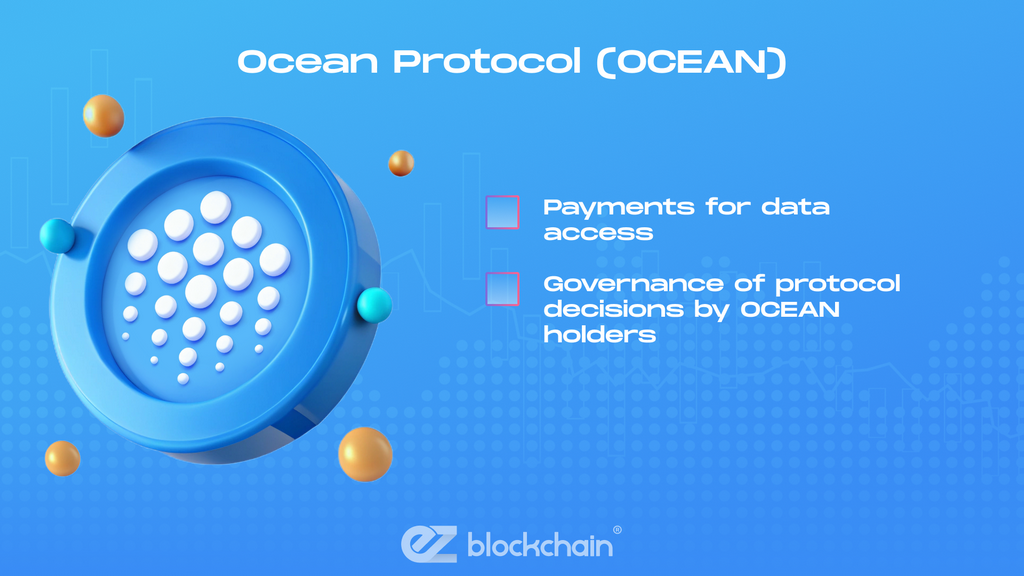
Ocean is a decentralized protocol for data exchange, which data providers can use to share or sell their datasets. AI developers, in turn, can access these datasets to start training AI models faster.
The OCEAN token’s utility includes:
Best used for: Privacy-preserving exchange and decentralized access to well-prepared data.
You get a lot of practical implementation with the above top AI coins to buy, but their ecosystems must still completely mature. For now, you can potentially benefit from:
While looking at some tangible advantages, the AI-crypto space also faces significant challenges and risks, like:
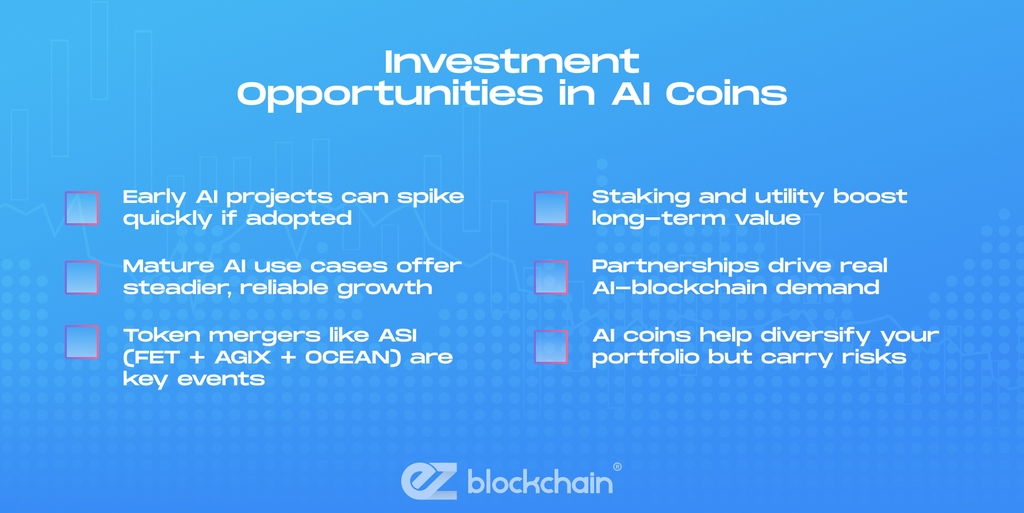
If you’re already considering investing in AI-powered crypto, here are some angles and prospects — and what to watch out for:
Last but not least, what should we expect from the emerging AI-crypto niche in the near future? We’d like to point out several fundamental trends to keep in sight:
Still have questions or can’t decide what AI crypto to buy for your purposes? Contact EZ Blockchain experts for an individual consultation, guidance, and profitable ASIC miner purchase and hosting.
Fill out a form and our bitcoin mining expert will contact you.
FREE CONSULTATIONFill out a form and our bitcoin mining expert will contact you.


AI-powered cryptocurrencies are blockchain projects that deeply integrate AI into their protocol. Rather than just serving as a payment or governance token, these coins can power autonomous agents (or AEAs), decentralized compute networks, or data marketplaces. In other words, they enable AI workflows — like model training, inference, or automated decision-making — to run in decentralized blockchain environments.