Count me in!
Stay up to date with the latest news, announcements, and articles.
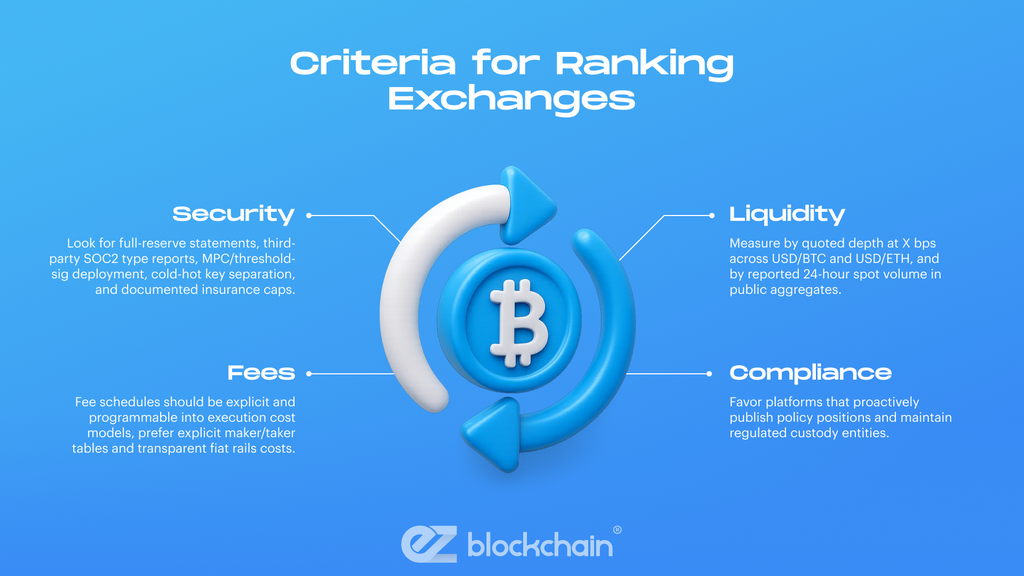
To create an apples-to-apples evaluation we use four dimensions with measurable subcomponents:
These four pillars drive the technical suitability of an exchange for institutional deployment. They are also the levers that materially affect execution slippage, counterparty risk, and operational compliance cost.
The ranking below applies weighting to security and compliance for institutional suitability, while still penalizing excessive fees or low liquidity for market participants needing tight execution.
Below are the platforms evaluated and their salient operational characteristics. After the list I include a compact technical comparison table.
Known for long tenure and hardened custody posture; enterprise custody products, SOC2/SOC3 disclosures in their ecosystem, and an active institutional custody offering that emphasizes proofable cold reserves and qualified custody integrations. Kraken also markets institutional custody and OTC services suited for treasury usage .
Retail-focused rails with commissionless trading and integrated brokerage/crypto execution; attractive for low-friction fiat on-ramps and retail liquidity, but historically limited in orderbook depth for large block execution relative to pro exchanges. Robinhood also advertises average cost benefits for small retail purchases .
High regulatory profile, publicly listed U.S. company with explicit policy engagement and custody offerings targeting institutional clients; prioritizes compliance automation and custody transparency. Coinbase is a de-facto baseline for institutional onboarding due to its audited custody stacks and regulated subsidiaries .
Broad product set (spot, derivatives, staking), competitive retail fee schedule and yield products; useful for execution that leverages staking and liquidity mining where allowed by U.S. rules. Crypto.com also provides advanced APIs for programmatic traders .
Retail and social trading platform that exposes crypto ownership in a trading wrapper; fees are often embedded in spreads rather than purely explicit maker/taker arithmetic, so execution cost modeling requires attention to spread dynamics. eToro publishes fee tables for reconciliation .
Emphasizes compliance and a full-reserve custodian position; publishes detailed reserve/segregation statements for USD stablecoin products and highlights trust-company governance. Gemini’s custody and institutional product set targets regulated investors .
U.S. arm of a long-running exchange with a conservative compliance-first approach; smaller liquidity pools vs. the largest U.S. venues but a focus on regulatory registrations and straightforward fee models.
Operating as the U.S.-specific arm of the global Binance brand, describes itself as a licensed U.S. exchange with FinCEN registration and a reduced asset set relative to Binance International. Liquidity is strong for on-chain pairs offered, but institutional teams must model spreads against global liquidity .
Legacy European exchange with a U.S. offering (through local entities/partnerships); known for conservative risk management and straightforward fee schedules; used as a venue for fiat pair access by international allocators. Forbes and other rankings continue to include Bitstamp among primary liquidity venues .
Smaller by volume in U.S. channels but notable for simple fiat rails and retail UX in partner markets, included for completeness where US customers use partner integrations or OTC access.
This top-10 list balances institutional requirements (security, custody, licensed entities) with execution realities (liquidity and fees). The ideal choice depends on allocation size, custody preferences, and regulatory risk appetite.
| Exchange | US Legal / Reg Status | Security Highlights | Typical Fee Footprint | Liquidity/Execution Notes |
| Kraken | US entity + custody products | MPC, cold storage, institutional custody; no major fund-loss breach publicly recorded . | Tiered maker/taker; instant buy spreads. | Institutional OTC desk; deep BTC/ETH orderbooks vs. many regional exchanges. |
| Robinhood Crypto | Brokerage with crypto arm | Custody was segregated; custody model typical for brokerages | Zero commission; spreads and small add-on fees. | High retail flow; limited for large block execution. |
| Coinbase | Public, regulated subsidiaries | Advanced custody, SOC audits, institutional prime & custody. | Clear maker/taker tiers on Coinbase Pro / Advanced. | Strong domestic liquidity and institutional orderflow. |
| Crypto.com | U.S. exchange entity | Exchange + staking programs | Competitive retail fees; staking reduces costs | Good retail liquidity; staking/earning effects on supply. |
| eToro | Select US states | Brokerage-like custody | Fees via spread; platform fees documented. | Social trading liquidity; not primary for deep block trades. |
| Gemini | NYDFS trust company | Full-reserve claim; segregated fiat; trust governance. | Fee schedule explicit; institutional pricing available | Strong compliance posture; institutional custody product. |
| bitFlyer USA | State registrations | Conservative custody / AML | Moderate fees | Smaller liquidity pools in the US. |
| Binance.US | FinCEN-registered U.S. platform | 1:1 customer funds claims; limited token set. | Competitive maker/taker; incentives | Liquidity concentrated on offered pairs; model cross-venue execution. |
| Bitstamp | Partnered US access | Legacy risk controls, conservative ops | Simple tiered fees | Reliable fiat pairs via global network. |
| Coinjar | Partner integrations | Basic custody via partners | Retail fee model | Niche/regional liquidity |
Use this table as a quick engineer’s reference: security controls and legal status determine counterparty risk; fee mechanics shape execution cost; and liquidity profiles determine slippage and market impact. For large allocations, add an OTC desk overlay and measure depth at multiple bps thresholds before routing.
Below is a prioritized checklist you can operationalize into an onboarding workflow; treat it as a programmatic algorithm for exchange selection.
Convert this checklist into a decision matrix and attach real numbers, maximum tolerable slippage (bps), legal approval time (days), and settlement latency (seconds/minutes). That quantitative matrix is what separates a risky integration from a production-grade one.
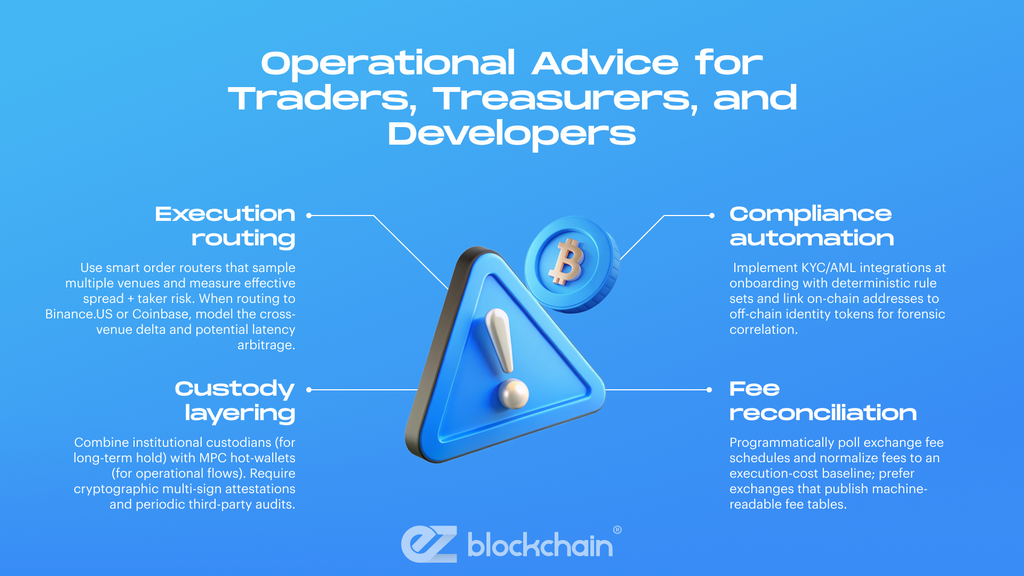
The practical stack for a production deployment is: institutional custody, primary exchange with deep liquidity, an OTC desk for block fills, smart execution routing, on-chain reconciliation and legal wrappers. Each component must be stress-tested and instrumented.
Choosing a U.S. crypto exchange for professional usage is a multidimensional optimization problem, minimize counterparty and regulatory risk first, then minimize execution cost within that constraint set. Use the tables, checklist, and operational advice above to produce a quantified decision matrix before you move significant capital onto any single platform.
Fill out a form and our bitcoin mining expert will contact you.
FREE CONSULTATIONFill out a form and our bitcoin mining expert will contact you.