Count me in!
Stay up to date with the latest news, announcements, and articles.
But however easy the process of staking may seem, it’s crucial to invest into the right coins — ones with enough reward potential to balance out the risk. When staking coins, your final reward can be shaped by the staked coin’s price dynamics, network health, validators, and overall market conditions.
If you’re considering staking, this article will be a quick guide on choosing the most credible crypto staking coins with a good promise of staking profits, underlying benefits and risks when staking, and other tips.
For 2025–2026, coins like Ethereum, Cardano, Solana, Polkadot, and Avalanche stand out with the most solid staking yields, striving ecosystems, and liquid profits.
So let’s take a look at them — right after we figure out some basics.
Staking is when you lock up the tokens you already hold in the network’s PoS protocol, thus helping support the network’s operation. All you need to do once you’ve staked the coin is wait until enough yield is generated and other rewards come your way.
Technically, token staking is one of the principal functionalities of Proof-of-Stake blockchains (and similar networks). The staked, or locked-up, coins provide the power for the network’s security procedures, transaction validations, and consensus tasks.
“ETH’s liquidity, ecosystem, and long-term viability give it more intrinsic value as a proven staking asset.” — EZ Blockchain
That is exactly what you’re rewarded for — helping maintain the blockchain’s operation and protection. The rewards are usually provided in the native token, as compensation for contributing.
One other important principle about staking is that you can either stake coins directly (if you run a validator node — the hard way) or, more commonly, delegate your token staking to a validator or staking pool.
The latter option basically enables anyone holding the coin to earn staking rewards, even with modest amounts in hand. This makes it quite accessible, but what more is there?
The best thing about staking is that there is really nothing at stake for the coin’s holder — once you’ve staked, your biggest worry is not making as much profit as you expected. Meanwhile, staking gives you advantages like:
Staking, when done right, is brimming with opportunities to make profits. But what crypto can you stake and, more importantly, what are the most profitable staking coins as of this moment? Let’s find out.
Below are some of the highest staking coins widely regarded as top staking options in 2025, thanks to a mix of yield, network strength, and usability.
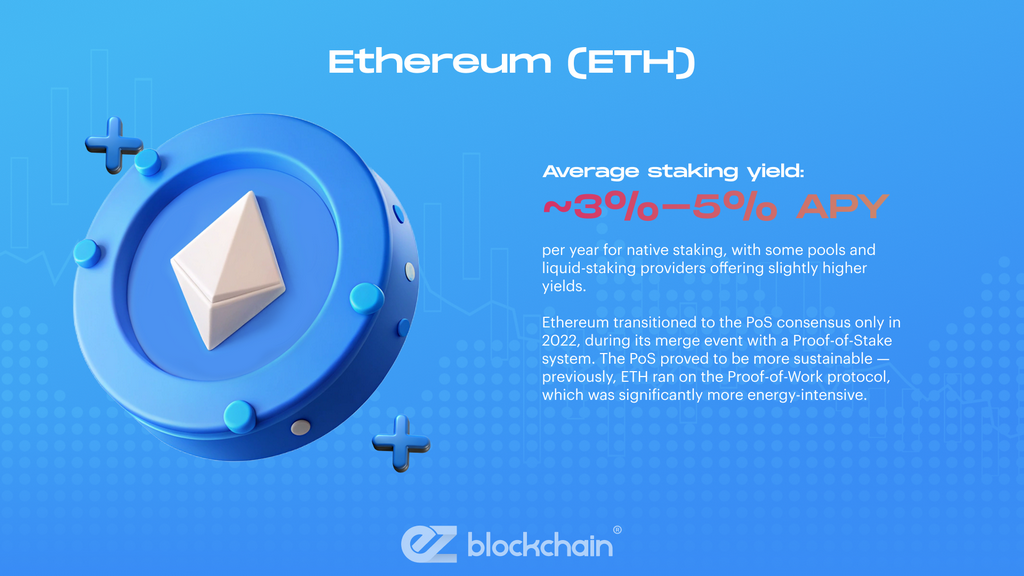
Ethereum transitioned to the PoS consensus only in 2022, during its merge event with a Proof-of-Stake system. The PoS proved to be more sustainable — previously, ETH ran on the Proof-of-Work protocol, which was significantly more energy-intensive.
After the merge, ETH staking remains among the go-to choices. As of 2025, increasingly more people participate, with a sizable portion of ETH supply staked globally. ETH staking yield tends to be modest compared to smaller PoS chains. But ETH’s liquidity, ecosystem, and long-term viability give it more intrinsic value as a proven staking asset.
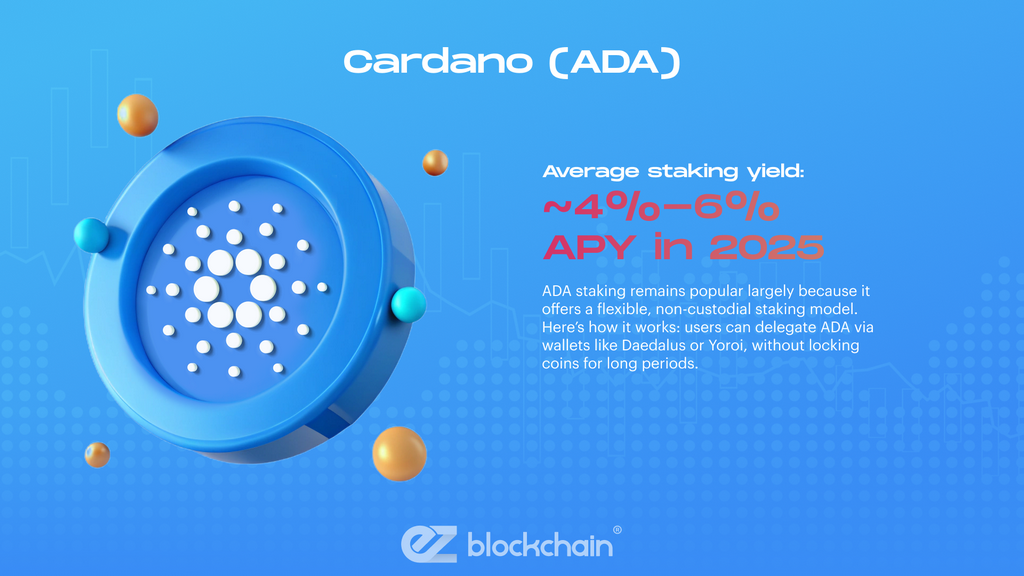
ADA staking remains popular largely because it offers a flexible, non-custodial staking model. Here’s how it works: users can delegate ADA via wallets like Daedalus or Yoroi, without locking coins for long periods.
ADA is a stable and accessible choice when it comes to passive income generation — you can easily yield ~4–6% APY. Cardano also boasts dedicated community and ongoing development, with smart contracts, sidechains, and other upgrades.
Solana’s staking rewards are currently among the more attractive for leading layer-1 blockchains — up to 6–8% APY in 2025. SOL is also an attractive candidate for staking and dedication due to its high-speed network, firm dApp/DeFi/NFT ecosystem, and relatively simple staking and delegation process with the help of popular wallets.
SOL is a perfect choice for users seeking a balance between yield and ecosystem activity — a solid mid-to-long term staking option with a safer entry point.
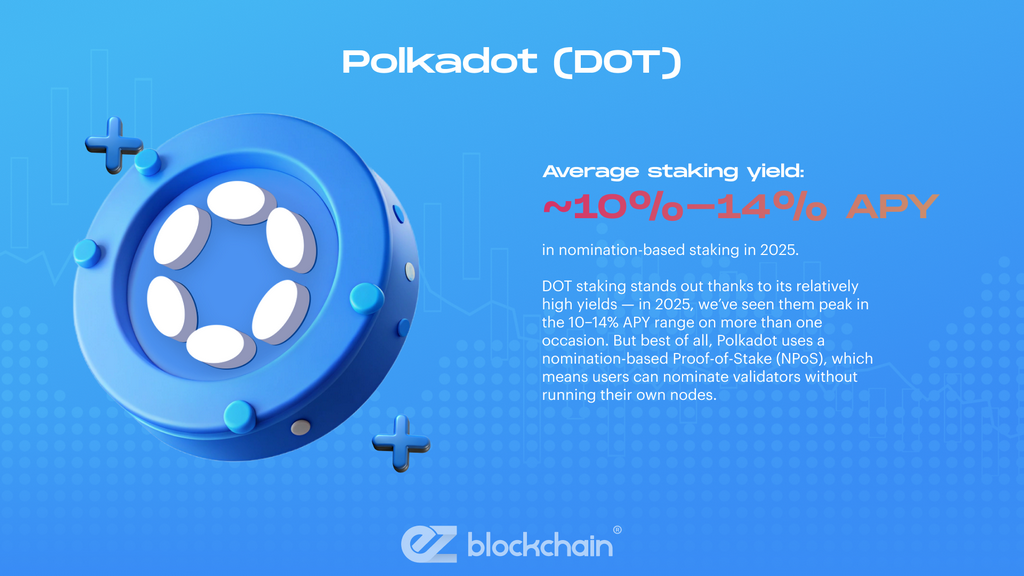
DOT staking stands out thanks to its relatively high yields — in 2025, we’ve seen them peak in the 10–14% APY range on more than one occasion. But best of all, Polkadot uses a nomination-based Proof-of-Stake (NPoS), which means users can nominate validators without running their own nodes.
This makes the inherently difficult process of direct staking accessible, while users may also stake through wallets if they like. All in all, DOT poses moderate protocol risk in exchange for higher yields.
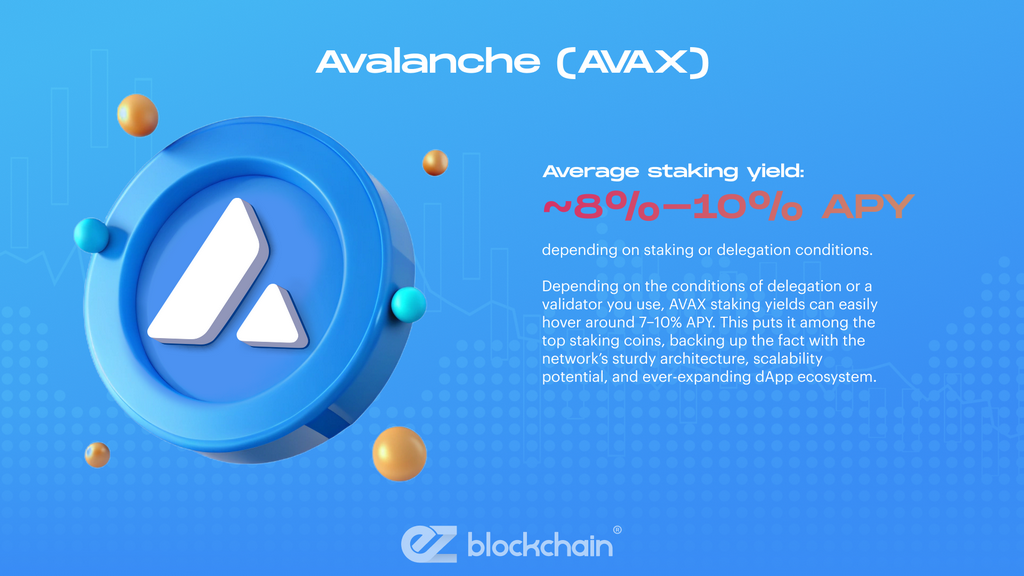
Depending on the conditions of delegation or a validator you use, AVAX staking yields can easily hover around 7–10% APY. This puts it among the top staking coins, backing up the fact with the network’s sturdy architecture, scalability potential, and ever-expanding dApp ecosystem.
AVAX provides a good mix of profit and utility, which you can leverage for a variety of income goals. However, for AVAX validators minimum staging requirements may be higher. But you can still find many staking pools that accept smaller delegations.
Now that you have a choice from the best crypto staking coins, it’s time to estimate just what rates of income you can achieve with each. In order to calculate your staking rewards, you need to count in and analyze several variables:
For example, if you stake 1,000 ADA at 5% APY, you could earn approximately 50 ADA in a year (before accounting for price changes, network fees, or compounding).
You need to work only with well-proven, reliable platforms, even if you stake the best Proof-of-Stake coins. Some of the top online platforms for the purpose include:
However, the list may go on infinitely due to the flexible mechanism of validation. Here are some pro tips, platform selection advice, and useful approaches:
Last but not least, even if you have the best staking coins in hand, the whole deal isn’t exactly risk-free. We are looking at:
Do you need help picking the best staking coin for your purposes? Talk to EZ Blockchain — we help figure out blockchains, estimate the profitability of your operations, and consult your next steps.
Fill out a form and our bitcoin mining expert will contact you.
FREE CONSULTATIONFill out a form and our bitcoin mining expert will contact you.