https://ezblockchain.net/article/will-bitcoin-crash-again-in-2026/
The question “will Bitcoin crash again in 2026?” cannot be answered with certainty, but by dissecting historical crash patterns, current market indicators, macroeconomic conditions, and structural vulnerabilities, we can build a rigorous risk model and plausible scenarios for what might drive a significant drawdown (or avoid one). This article guides you through those factors, shows possible triggers, and recommends risk‑aware strategies for investors.
Historical Bitcoin Crashes: Lessons from 2013, 2017, 2021
Before forecasting 2026, it’s useful to review past cycles to understand frequency, magnitude, and underlying catalysts.
Here are major drawdowns in Bitcoin’s history:
- Late 2013 → Early 2015: After soaring from below $200 to ≈ $1,150 in Nov 2013, Bitcoin crashed roughly –86 % over the following 14–15 months .
- 2017 → 2018: The 2017 bull run pushed BTC from ~$970 to nearly $19,800; by end‑2018, BTC had lost over –84 %, bottoming near $3,200.
- 2021 → 2022: After peaking in late 2021 (≈ $69,000 on many charts), BTC declined ~ 77–80 % through 2022.
These crashes shared some common traits: rapid speculative run‑ups, over-leveraged derivatives positions, macroeconomic shocks or regulatory pressure, and liquidity stress when many holders attempted to exit simultaneously .
Key lessons from history:
- Bitcoin cycles tend to exhibit boom → bust → consolidation patterns.
- Magnitude of drawdown often correlates with excess leverage, bubble‑like speculative inflows, or macro/regulatory shocks.
- Recovery takes time; during deep drawdowns, many holders see 70–90 % losses before bottoming out.
- “Crash events” are more likely to originate from structural stress (leverage, liquidity, regulation) rather than purely technical chart patterns.
History shows steep drawdowns are part of Bitcoin’s long‑term dynamic. Investors must recognize that high returns tend to come with high risks, and that no rally is immune to systemic shocks.
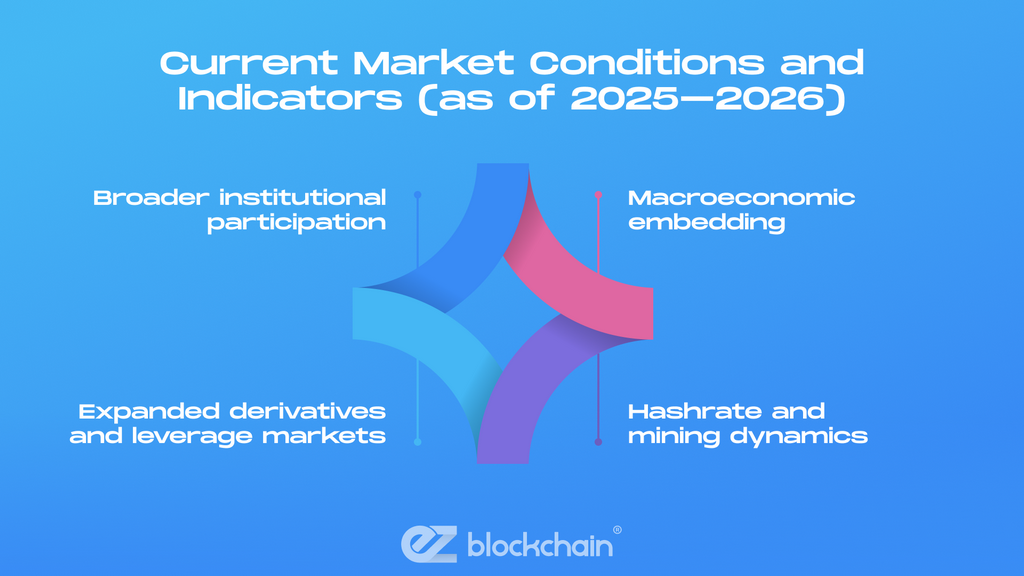
Current Market Conditions and Indicators (as of 2025–2026)
BTC today operates in a vastly different environment than in 2013 or 2017. Key structural changes influence both resilience and risk exposure. Notably:
- Broader institutional participation – More ETFs, funds, corporate treasuries, and regulated exposure. Institutional flows have added liquidity and depth.
- Expanded derivatives and leverage markets – While maturity helps, leverage still magnifies downside; liquidation cascades in derivatives can amplify drawdowns .
- Macroeconomic embedding – Bitcoin increasingly behaves like a risk asset; macro conditions (interest rates, inflation, policies) affect BTC just like equities or commodities .
- Hashrate and mining dynamics – The underlying security of the network remains tied to mining economics; shifts in energy cost, regulation, or miner profitability can create structural supply‑side stress .
A recent example: in early 2025, BTC experienced a sharp drop, the largest monthly decline since mid‑2022, driven by macro volatility and risk‑off sentiment across global markets .
The evolution of Bitcoin’s ecosystem has increased its institutional robustness, but also its sensitivity to systemic global shocks and macroeconomic cycles. That duality frames both upside potential and crash risk.
Factors That Could Trigger a Crash in 2026
Predicting a crash involves stress‑testing the system against a combination of external shocks, structural vulnerabilities, and market dynamics. Below are plausible triggers for a significant drawdown in 2026.
- Macroeconomic shock & monetary tightening: If central banks continue or accelerate interest‑rate hikes (e.g. to counter stubborn inflation), risk assets like Bitcoin may see capital rotation toward yield‑bearing instruments .
- Major regulatory crackdown or unfavorable policy: New regulation targeting mining, exchange operations, or institutional holdings, or geo‑political events affecting mining infrastructure, could spook markets .
- Derivatives unwind / liquidity stress: A sudden deleveraging in futures/perpetual markets, perhaps triggered by macro volatility, could cascade into forced liquidations, causing sharp price drops.
- Mining‑economic pressure: Rising energy costs, tougher environmental regulations, or hardware constraints may push some miners offline, reducing hashrate and undermining confidence.
- Massive negative sentiment shift / panic selling: A cross‑asset crash (stocks, real estate, commodities) could trigger risk‑off flows in crypto en masse.
- Systemic event, hack, major exchange insolvency, or stablecoin collapse: A high‑profile failure in the crypto ecosystem could destroy confidence and trigger wide sell‑off .
A “perfect storm” of macroeconomic, regulatory, and structural shocks could trigger a severe BTC crash in 2026. Given increased complexity and interdependencies, risk exposure may now be greater than in prior cycles.
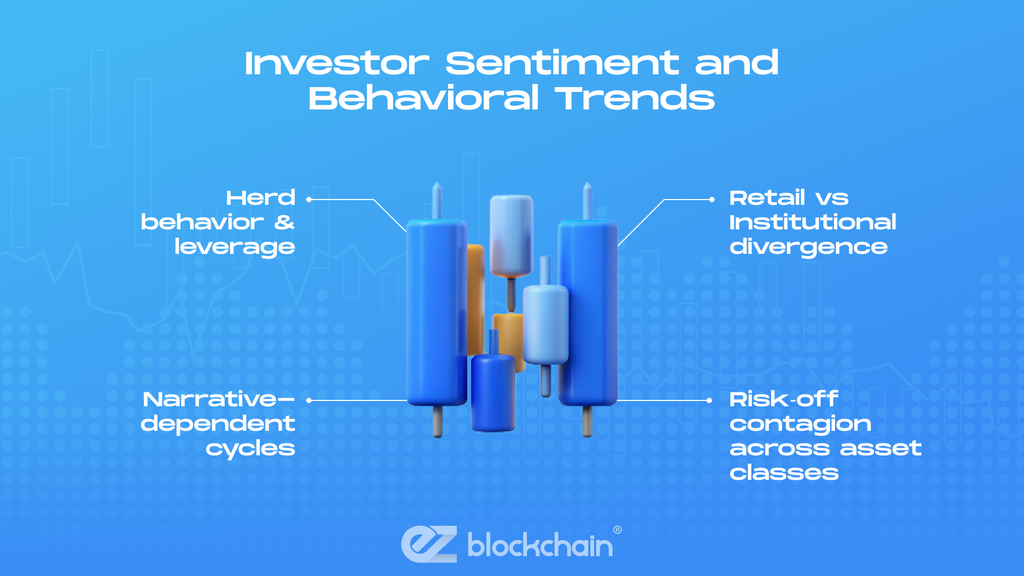
Investor Sentiment and Behavioral Trends
Bitcoin remains heavily driven by investor psychology, FOMO during run‑ups and panic selling during drawdowns. Behavioral cycles intensify outcomes:
- Herd behavior & leverage: In bull runs, many investors, retail and institutional, take leveraged positions, amplifying upside but also downside risk when sentiment shifts.
- Narrative-dependent cycles: Crypto markets react strongly to macro‑economic or news-driven narratives (halving events, ETF approvals, regulation). Changes in narrative can reverse price direction quickly.
- Retail vs Institutional divergence: Retail investors often react emotionally, while institutions may rebalance or liquidate systematically, under heavy drawdown, retail exodus can magnify price drops.
- Risk‑off contagion across asset classes: As crypto becomes more correlated with broader markets, collective shifts in risk sentiment can trigger synchronized outflows.
Sentiment remains a dominant amplifier of price moves, it can drive bubbles on the upside, and cascade crashes on the downside, especially when leverage and liquidity stress are present.
Institutional Participation and Risk Mitigation
On the flip side, institutional involvement adds resilience and structural depth to Bitcoin’s market. However, it also introduces new risk vectors:
Stabilizing factors:
- Institutional investors and funds tend to have longer time horizons, better risk controls, and more diversified portfolios, reducing panic-driven cycles.
- Larger market depth improves liquidity, enabling smoother exits even during drawdowns.
- Public disclosures, hedging strategies, and regulated vehicle constraints can anchor some portion of holdings, reducing circulating supply pressure during volatility.
Institutional adoption increases market depth but also binds Bitcoin more tightly to macro‑systemic financial cycles, making BTC less of an isolated speculative asset and more a component in broader financial risk portfolios.
How Mining Profitability Affects Price Stability
Mining remains the bedrock of Bitcoin’s security and supply dynamics. Economic incentives for miners, primarily block rewards and transaction fees vs. energy and hardware costs, influence supply pressure and network security.
Key technical facts:
- When mining profitability drops (low BTC price and high energy cost / difficulty), some miners may shut off rigs or exit, reducing hashrate, which could increase risk perceptions and trigger sell pressure .
- Conversely, if price drops significantly below marginal cost of production, miners may attempt to sell reserves rapidly to cover expenses, further pressuring price downward. Historical cost-of-production models have been used to estimate a “fundamental floor” for price .
- Mining‑related external risks, regulatory crackdowns, energy‑price spikes, or resource constraints, add another layer of uncertainty .
Mining economics are a subtle but real supply‑side control on Bitcoin’s stability; if profitability becomes unfavorable in 2026, coin supply pressure could coincide with macro stress to produce deep downside.
Serious holders and allocators should track several data feeds and analytics regularly. Useful tools/metrics include:
- On‑chain analytics (exchange inflow/outflow, supply concentration, long‑term holder metrics)
- Futures open‑interest and funding‑rate data (to gauge leverage and liquidation risk)
- Mining‑economics dashboards (hash‑rate, difficulty, energy costs, miner reserve behavior)
- Macroeconomic indicators (real rates, inflation data, bond yields, global risk indices)
- Sentiment & social‑network analytics (whale activity, social sentiment, news cycles)
- Derivatives‑market stress signals (skew, option implied volatility, funding rate divergences)
Monitoring both on‑chain and macro/derivatives signals offers a multi-dimensional early‑warning system; the complexity of modern crypto markets demands a hybrid risk‑data approach.
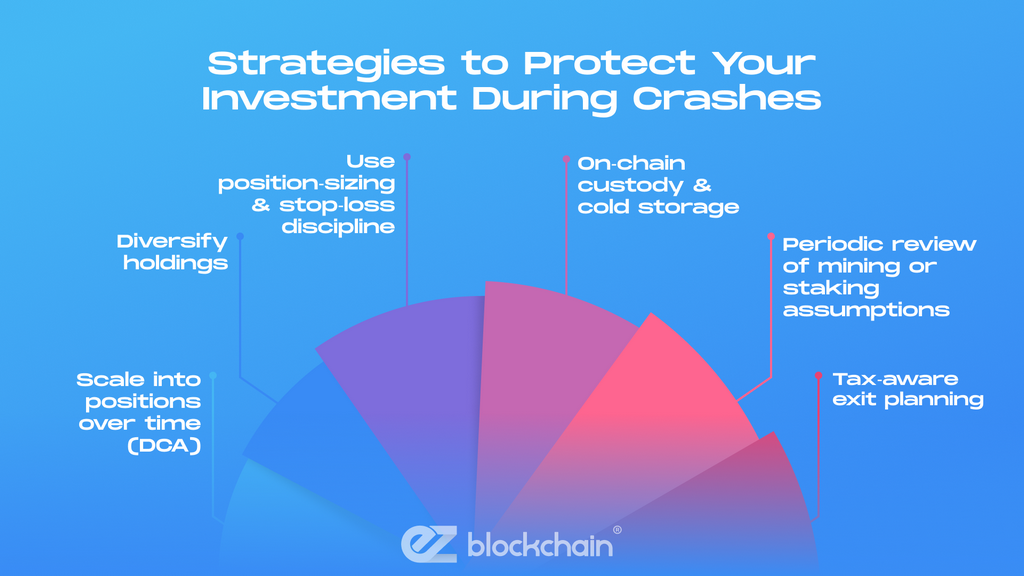
Strategies to Protect Your Investment During Crashes
Given the inherent risks, here are defensive strategies for 2026 that reflect structural realities:
- Scale into positions over time (DCA) – reduces timing risk, avoids full allocation at cycle tops.
- Diversify holdings – maintain a mix of long‑term allocation (hodl), staking/earning yield assets (where regulatory‑compliant), and stablecoins or non‑correlated assets to buffer volatility.
- Use position‑sizing & stop‑loss discipline – manage risk per holding, avoid over‑leverage, keep portion of portfolio unexposed.
- On‑chain custody & cold storage – reduce institutional counterparty risk, avoid exchange‑specific failures if crash triggers exchange insolvency.
- Periodic re‑assessment of mining‑cost or staking‑yield assumptions – adjust outlook if production costs or network parameters change.
- Tax‑aware exit planning – factor in capital‑gains tax buckets, which may influence timing of sales in downturns.
Protective strategies don’t eliminate risk; they manage it. In a market as volatile and complex as Bitcoin’s, disciplined risk management and diversified allocation are the only reliable shields.
Crash Risk Drivers vs Stability Buffers (2026 Context)
| Risk Driver / Trigger |
Description / Mechanism |
Stability Buffer / Counteracting Force |
| Macro shock (rates, inflation, recession) |
Risk‑off flows, capital rotation away from volatile assets |
Institutional holdings, long-term investors, global adoption |
| Derivatives unwind & leverage liquidation |
Forced sales cascade driving price down rapidly |
Improved derivatives infrastructure, better margining, risk limits |
| Mining‑cost pressure / hashrate drop |
Reduced mining profitability may force sell‑off by miners |
Hash‑rate redistribution, miner capex cycles, halving inertia |
| Regulatory/exchange‑specific shock |
Legal or compliance events affecting exchanges or jurisdictions |
Global decentralization, self‑custody resilience |
| Sentiment collapse or panic selling |
Herd behavior, social panic leading to mass liquidations |
Hodl culture, long-term adoption stories, network fundamentals |
| Over‑valuation after speculative bubble |
Price detached from fundamentals leading to sharp correction |
Use of valuation models (cost‑of‑production, discounted cash‑flow analogies) |
Viewing crash risk through a matrix of triggers and buffers helps contextualize potential drawdowns, it shows which threats are structural, which are cyclical, and which can be hedged or mitigated.
Conclusion: Risk‑Aware Bitcoin Investing in 2026
There is a realistic path for Bitcoin to crash again in 2026. The magnitude and timing are uncertain, but structural vulnerabilities, macroeconomic exposure, and behavioral risk make a deep correction plausible.
That said, current market evolution also builds in stability buffers: institutional depth, diversified mining distribution, improved infrastructure, and investor sophistication.
For anyone holding or allocating Bitcoin in 2026, prudent action isn’t about predicting a crash, but about building a risk-aware, diversified, and resilient portfolio that anticipates volatility. Use the frameworks above, monitor on‑chain & macro signals, manage position sizing, diversify, employ sound custody practices, and treat Bitcoin as a high‑volatility component of a broader allocation, not a guaranteed fast‑track to profit.
Risk doesn’t disappear, but with care and discipline, downside can be managed and long‑term value preserved.
HOST YOUR MINERS WITH EZ!
Fill out a form and our bitcoin mining expert will contact you.
FREE CONSULTATION
Help me
choose
a miner
How to calculate
profit and
understand data?
How to setup mining
business remotely
with EZ Blockchain?
FREE CONSULTATION
Fill out a form and our bitcoin mining expert will contact you.